

A review and sample photos of the SONY Cyber-shot DSC-RX1 35mm full-frame sensor compact digital camera.
- Please see the disclaimer regarding advertising here.
- Italicized links in the text are advertisement links that take you to other sites.
- If you find any images used on this site problematic, please contact us via the comments or inquiry form, either as the rights holder or their representative. We will review the matter and take appropriate action.
able of contents

Gallery
Review

1.Overview
The SONY DSC-RX1 is a compact digital camera released by Sony in 2012.
Its main specifications are as follows:
- 24-megapixel, 35mm full-frame CMOS sensor
- Zeiss Sonnar T* 35mm f/2 lens for 35mm film format
- Fixed focal length lens (8 elements in 7 groups)
- 3-inch, 1.23-megapixel rear LCD screen
- ISO sensitivity: 100-25600 (extended sensitivity available)
- Recording media: SD card, Memory Stick Duo
- Battery: NP-BX1
2.Usability
The SONY DSC-RX1 is a built-in lens camera equipped with a 35mm full-frame sensor.
It has been 14 years since it was first released, and the repair period ended two years ago, with the end of support for repairs in August 2024. This is likely one reason for the increase in used cameras since 2025.
The RX1’s lens is the SONNAR T* 35mm, a new design exclusive to the RX1 series with a lens configuration of 8 elements in 7 groups and a built-in leaf shutter.
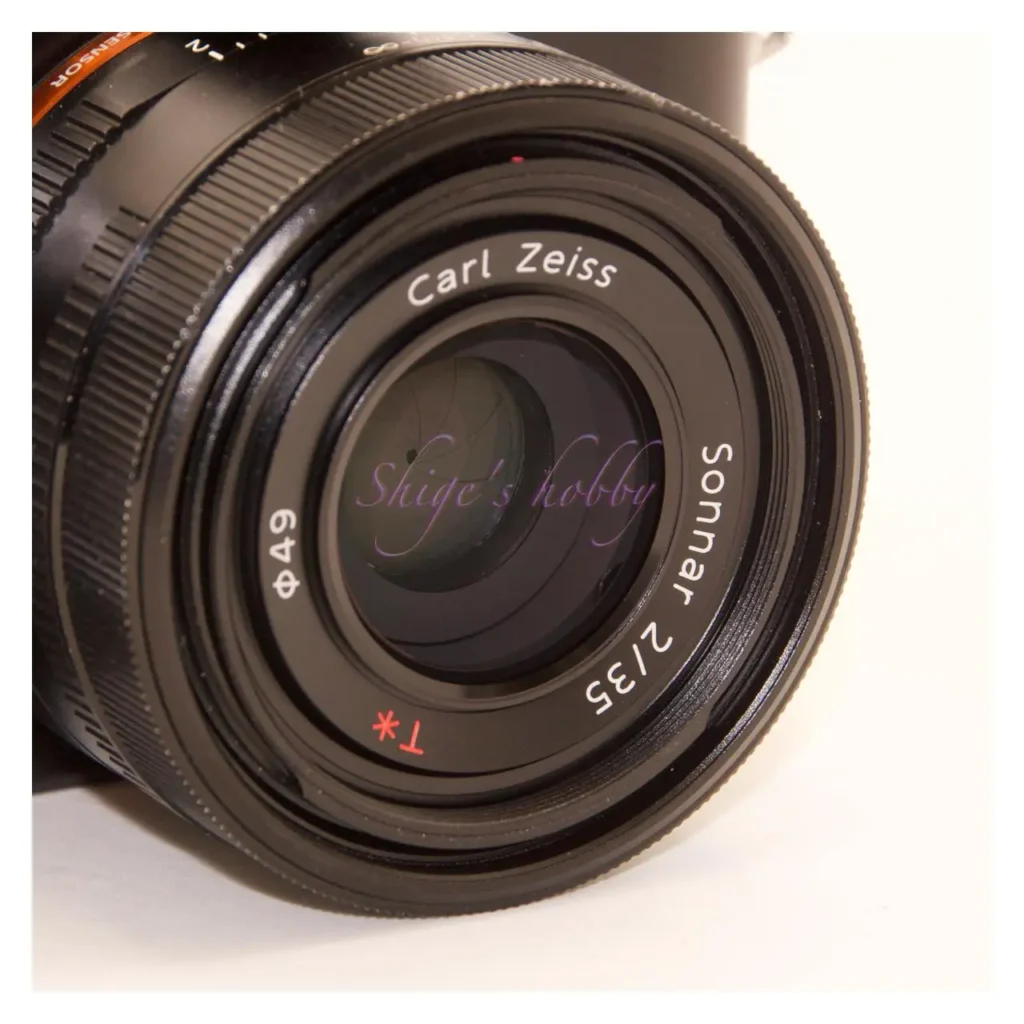
The DSC-RX1’s specified maximum shutter speed is 1/4,000 second, but this is only effective when the aperture is stopped down to f/5.6 or above. The maximum shutter speed is 1/3,200 second from f/4 to f/5, and 1/2,000 second from f/2 to f/3.5, with the shutter speed varying with aperture. This is because the lens shutter also functions as the aperture, and faster aperture settings allow for faster shutter speeds as the aperture moves more slowly.
Originally, the shutter speed was planned to be standardized at 1/2000 across all apertures, but since a high-speed shutter was available, the specifications were changed to 1/4000 from f/5.6 onwards. Since the upper limit of the lens shutter speed for Hasselblad’s H-series medium-format digital lenses, released in the mid-2010s, was 1/2000, it is likely that this lens’s lens shutter also incorporates the latest shutter available at the time.
The captured images show almost no noticeable lens distortion, depicting straight lines as straight lines, with minimal false colors. There’s also minimal flare or ghosting in backlit situations, demonstrating the power of the dedicated lens. Color balance isn’t particularly meaningful in Raw, where adjustments are available. While the JPEG standard settings are muted and understated, the “Picture Effects” function offers seven different options for more dramatic effects.
Thanks to the bright f/2 lens and 35mm full-frame sensor, low-light shooting results are excellent. Noise reduction isn’t excessive, and the resulting ISO sensitivity is appropriate.
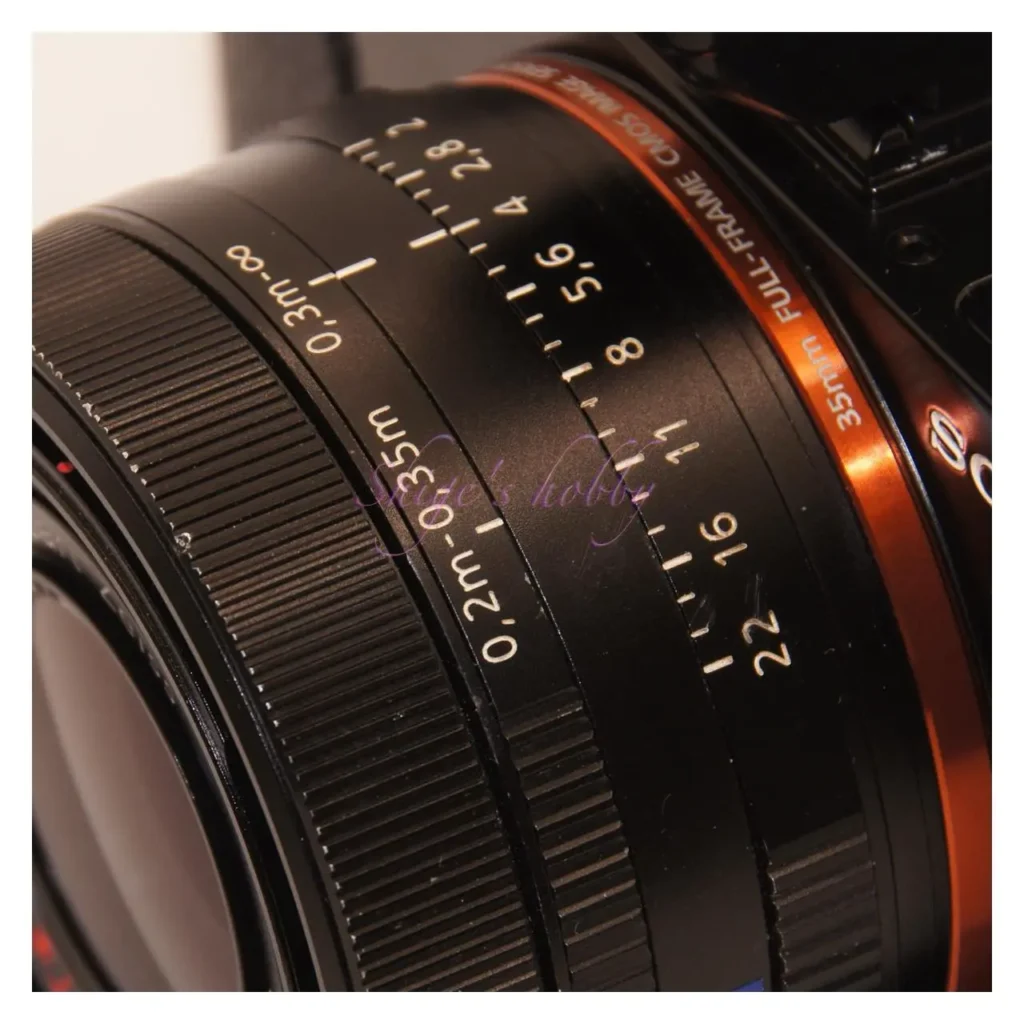
One disappointing aspect of operation is that the lens barrel lacks a physical distance marker, meaning the focus ring rotates infinitely. To focus, you need to switch to manual focus and adjust the focusing distance display on the LCD screen. This lack of intuitive control of the focusing distance can be a bit inconvenient for experienced photographers. Similarly, the fact that the focus ring doesn’t stop at the minimum focusing distance during macro shooting is equally inconvenient.
While the autofocus is largely problem-free for distant subjects, focus accuracy is unstable at close distances of less than 0.5m. In particular, once the focus is set to a different location than intended, pressing the shutter button again tends to reset it to a location close to where it was set; the focus search algorithm for close-up photography is unrefined.
To assist with close-up photography, the lens barrel is equipped with a macro mode that uses a dedicated rotating ring, but its setting range is 0.35 to 0.2m, making it difficult to use due to its narrow focusing distance range. It’s also unfortunate that this distance range does not cover the 0.5m range where focus accuracy drops in normal focus mode.
It would be better to limit this macro mode to around 0.5m to 0.2m, but it’s possible that the autofocus algorithm was unable to accommodate the wider focusing distance range.
Furthermore, it would be better if the photographer could set the upper limit of the macro mode in the menu, but this may be difficult due to the limitations of the autofocus algorithm.
This drawback can be overcome by setting the focus mode to DMF, allowing you to manually adjust the focus by turning the focus ring when autofocus fails.
The difference between the RX1’s AF and DAF is whether MF interrupt is possible or not when shooting still images, so if you use DAF, MF interrupt will be possible at all times.
The manual states that there is a difference between AF and DAF when shooting video, and that when set to AF, it functions as C-AF (continuous focus).
Aperture can be adjusted using the aperture ring on the lens barrel, and adjustment steps are in 1/3 increments, as used on recent Zeiss lenses.
The rear display, a 1.23 million dot LCD that you’ll always be looking at when shooting without an EVF, offers ample specs for checking composition and image quality. If you’re unsure of the focus when shooting at maximum aperture, it’s best to turn the focus ring to zoom in and confirm the focus before pressing the shutter.
The mode dial offers all the necessary options: M, S, A, P, AUTO, SCN, WIDE, MOVIE, and three custom modes, but since this is a camera with an aperture ring, the aperture-priority A mode is the primary setting.
The exposure compensation function has a dedicated dial on the top right, making it very easy to use.
The shutter button has a screw hole, as seen on older SLRs and rangefinder cameras, so you can customize it with your preferred button. The shutter button is shallow, so if you want a slightly higher button, attaching a button of some kind would be easier.

There are also plenty of independent buttons, and settings can be assigned to a total of five keys: C, AEL, down wheel, right, and left. I use them with the following settings, and although “C” and “AEL” are used to increase the number of MF interrupt options, I rarely use them. I also don’t use the “down” focus magnifier much because it’s inconvenient to press a button and then press the round button in the center of the wheel to zoom. These three buttons do not have any particular functions that can be assigned to them, so for now I have assigned the focus magnifier function to them.
I set the image quality to “Right” because I need to change it to JPG when using the Smart Teleconverter. The opposite “Left” is assigned to the Smart Teleconverter, which can only be used with JPG.
- C: AF/MF control while pressing
- AEL: AF/MF control after pressing
- Bottom: Focus magnification
- Right: Image quality
- Left: Smart teleconverterーター
I tried using the Smart Teleconverter to shoot at 50mm and 70mm equivalents, but since the results were not much different from cropping the Raw images myself, I rarely used it. The LEICA Q also has a similar function, but I occasionally used it because it applied the same pseudo-teleconverter only to JPEGs when shooting Raw+JPEG. The RX1’s Smart Teleconverter can only be applied in JPEG mode, making it less convenient.
The battery is an NP-BX1, commonly used in compact digital cameras, with a voltage/capacity of 3.6V/1240mAh (4.5Wh), a weight of approximately 25g, and dimensions of approximately 29.9×42.7×9.2mm. Perhaps because Sony is confident in its power-saving features, it uses a small battery, but the power draw is still small at 4.5Wh (the LEICA Q’s BP-DC12 is 8.7Wh). The rated shot capacity is 270 shots, but with a slightly worn battery, I can only shoot around 150 shots, leaving only about one shot remaining. It’s unclear how many more shots I can get from there.
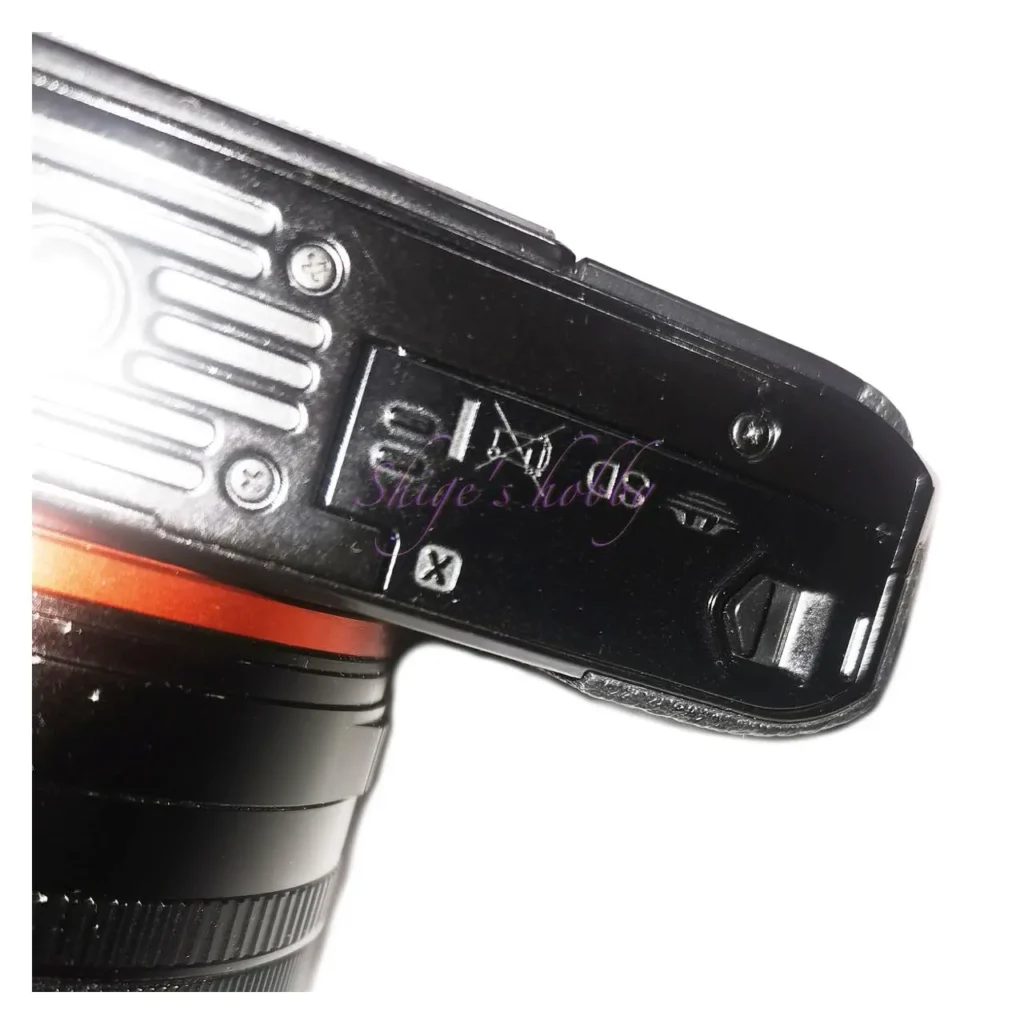
The battery cover is a plastic lid with a sliding locking mechanism, which prevents the battery compartment from opening and closing accidentally.
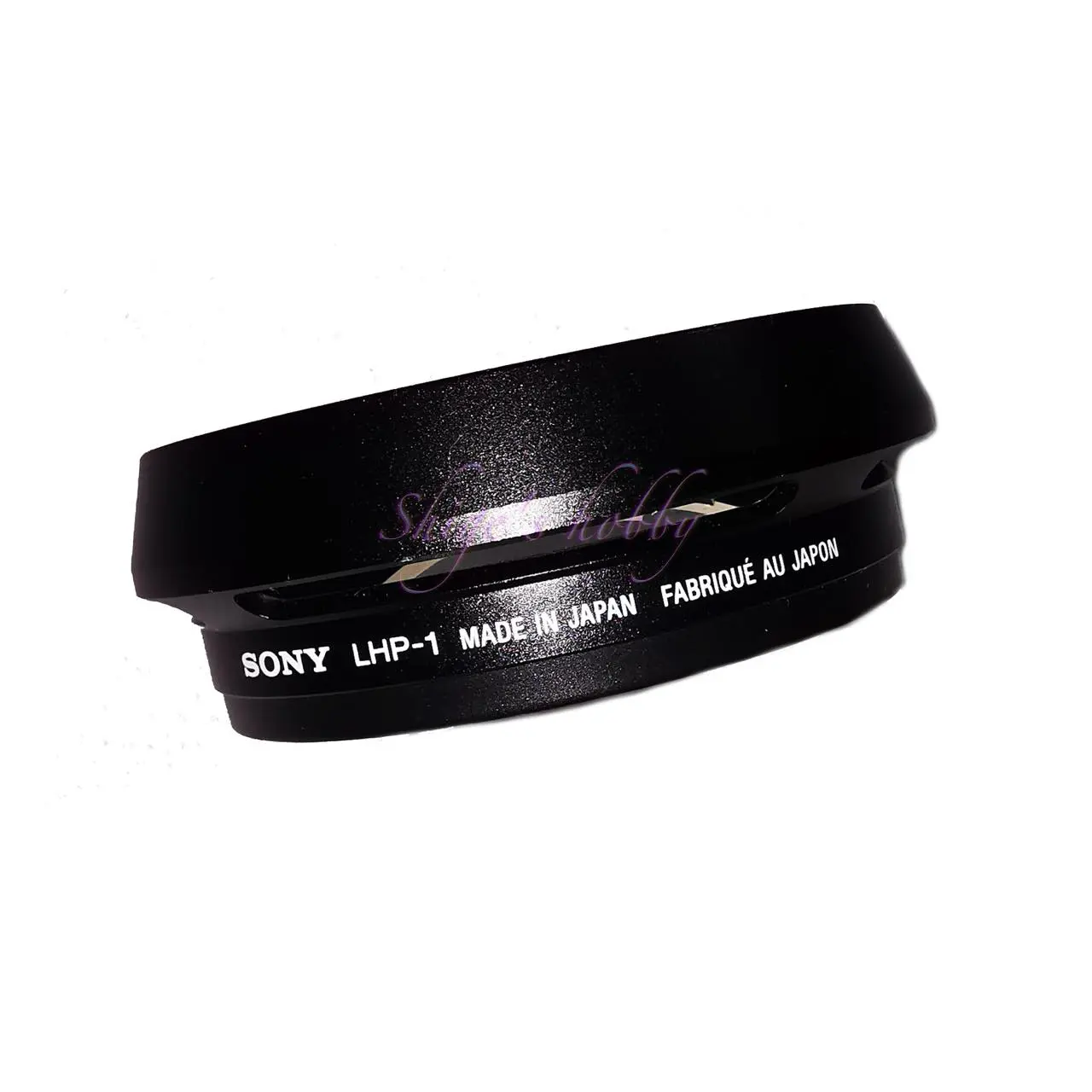
The options for the RX1 are quite expensive, with the dedicated bayonet hood costing 20,000 yen and the external electronic viewfinder around 30,000 yen, so if you try to purchase them later, you’ll need to be prepared to spend about half the price of a used body for both together.
Having used both, I’d say the EVF is convenient as it can be tilted to 90 degrees and is worth getting, but the hood is not necessary as the lens has a fair degree of resistance to backlight.
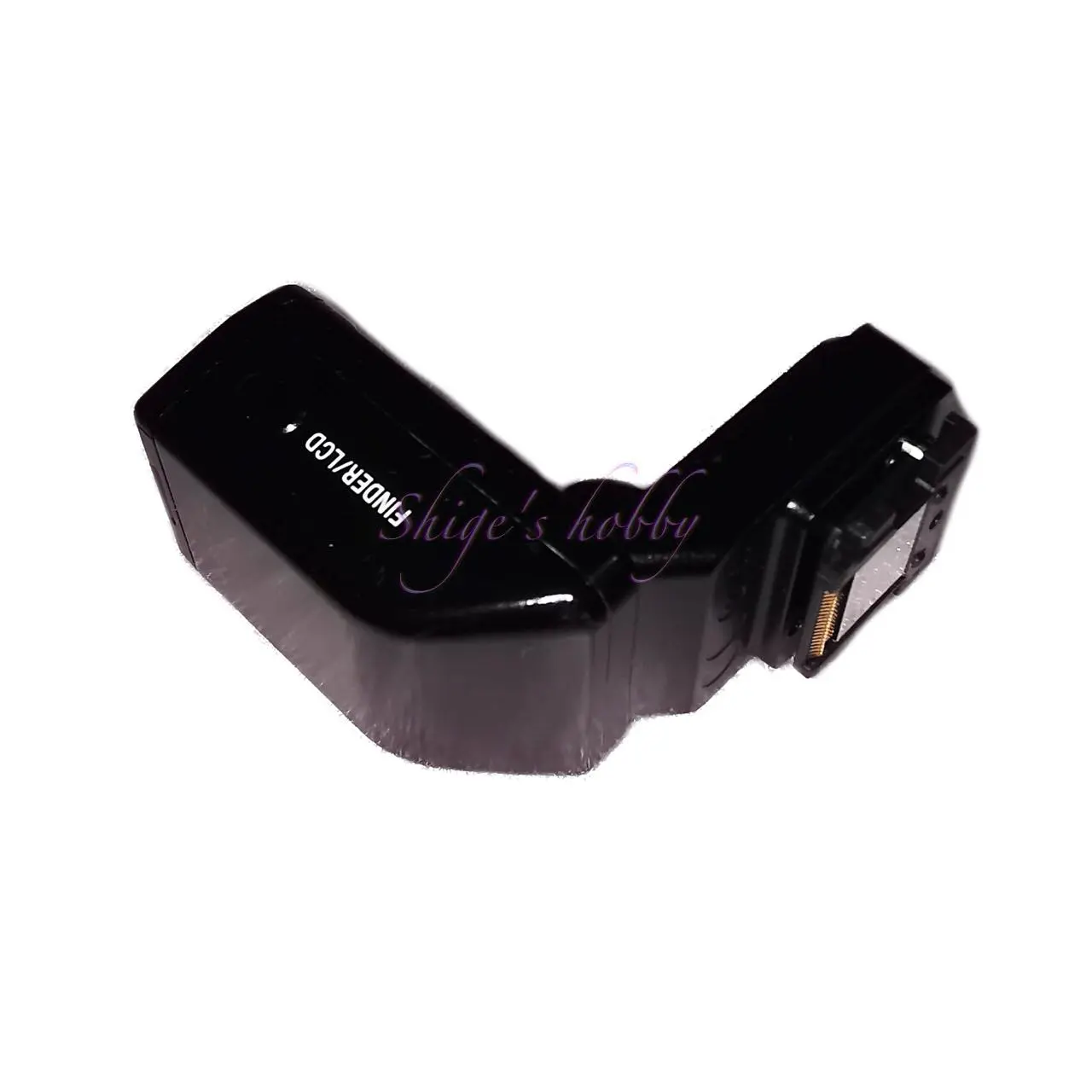
The EVF is smaller than those for the Canon G1X Mark-II and Panasonic DMC-LX7, and given the camera’s small size, it doesn’t get in the way. Considering the price, the exterior is made of plastic, and the EVF’s diopter adjustment is a tiny slide switch on the right side of the EVF, which makes it feel even cheaper. The only saving grace is that this slide switch isn’t loose enough to move around in a bag.
Finally, all used RX1s have dust on the sensor surface, and when I test shot with the camera I bought in the store, I noticed faint dust visible from F8 onwards, but when I stopped down to F16, the dust was clearly visible. Since I normally only stop down to F5.6, I thought it was acceptable, so I bought it.
Mapcamera and other cameras clearly state that dust may be visible, so you can prepare for it before purchasing. However, if you’re buying from a random second-hand store or auction, if there’s no mention of dust, it’s important to check whether the store or seller will accept returns if dust is visible when the aperture is narrowed.
If you buy on impulse, you need to think about how much garbage you can tolerate.
3.Summary
To summarize the SONY DSC-RX1, it’s a Sony 35mm full-frame sensor integrated lens camera.
Aside from the large lens, the camera’s size is truly that of a compact digital camera, making it ideal for portability and as a secondary camera. Its body is smaller than the Leica Q, and apart from the smaller battery life, it’s a perfect package.
While there are some negative aspects, such as the lack of a built-in EVF and short battery life, the advantage of being able to easily carry a camera with a 35mm full-frame sensor is irreplaceable. Furthermore, while successor cameras have become more advanced with features like built-in EVFs, the increased pixel count has made post-processing more difficult, so the original RX1 with its 24-megapixels offers just the right balance of camera specifications.
Specifications, considerations, etc.
The LEICA Q series has a similar concept to the DSC-RX1. The LEICA Q series includes three generations of cameras with a 28mm lens (Q, Q2, and Q3), and two focal lengths (Q3 and later) with a 43mm sensor. The Q2 and Q3 are also available with monochrome sensors.
This is in stark contrast to Sony, which has maintained a focal length of 35mm for all three models.
The SONNAR T* 35mm F2 lens has the rearmost element quite close to the sensor and also has a built-in shutter, making it a completely different lens from the similarly-specified SONNAR T* 35mm F2.8 for E-Mount mirrorless cameras.
| Items | RX1/RX1R | RX1RMII | RX1RMIII |
| lens brand | SONNAR | SONNAR | SONNAR |
| Lens Construction | 8 elements in 7 groups (3 aspherical lenses including AA lenses) | 8 elements in 7 groups (3 aspherical lenses including AA lenses) | 8 elements in 7 groups (3 aspherical lenses including AA lenses) |
| Focal length | 35 | 35 | 35 |
| Max aperture | 2 | 2 | 2 |
| Min aperture | 22 | 22 | 22 |
| Aperture blade | 9 | 9 | 9 |
| Minimum distance | 0,3m-∞ 0,2m-0,35m(macro mode) | 0,3m-∞ 0,2m-0,35m(macro mode) | 0,3m-∞ 0,2m-0,35m(macro mode) |
| Pseudo focal length | Smart Teleconverter 1.4x (50), 2x (70) | Smart Teleconverter 1.4x (50), 2x (70) | Step Crop 1.4x (50), 2x (70) |
| Numbers of pixels | 24.3 | 42.4 | 61 |
| Sensor type | 35mm Full Frame | 35mm Full Frame | 35mm Full Frame |
| View Finder | Retrofit 2.35 million dots FDA-EV1MK | 0.39 type OLED 2.36 million dots | 0.39 type OLED 2.36 million dots |
| Back LCD | 3.0 (4:3 fixed) / 1.23 million dots | 3.0 (4:3 fixed) / 1.23 million dots | 3.0 (4:3 fixed) / 2.36 million dots |
| Shutter speed(sec) | 30〜1/4000 F2=High limit 1/2000 | 30〜1/4000 F2=High limit 1/2000 | 30〜1/4000 F2=High limit 1/2000 |
| Electric Shutter speed | – | – | 30秒〜1/8000秒 |
| Filter size | 49 | 49 | 49 |
| Battery | NP-BX1 3.6V 1240mhA 4.5Wh | NP-BX1 3.6V 1240mhA 4.5Wh | NP-FW50 7.2V 1020mAh 7.3Wh |
| Nominal number of shots | 270 | 220 | 270〜300 |
| wireless charging | – | – | – |
| Memory card | Memory stick Duo SDXC | Memory stick Duo SDXC | SDXC |
| Size(mm) | 113.3 x 65.4 x 69.6 | 113.3 x 65.4 x 72.0 | 113.3 x 67.9 x 87.5 |
| Wight(g) | 482 | 507 | 498 |
| Release date | 2012.11.16 | 2016.2.19 | 2025.8.8 |
| Body color | Black | Black | Black |
Options
- LHP-1 J2…Lens hood
- ACC-TRBX…Accessory Kit
- FDA-EV1MK…Electronic Viewfinder Kit
- FDA-V1K…Optical Viewfinder Kit
- TGA-1…Thumb Grip
- FA-SHC1M…shoe cap
- NP-BX1…Rechargeable battery pack
- LCJ-RXB…Jacket case
- SD CARD (SDHC,SDXC)
- Memory Stick/Memory Stick Pro
Reference links
- RX1(DSC-RX1)・SONY Official page
- Notice of specification change for the Cyber-shot DSC-RX1 digital still camera・SONY Official page
- RX1R(DSC-RX1R)・SONY Official page
- RX1RII(DSC-RX1RM2)・SONY Official page
- RX1R III(DSC-RX1RM3)・SONY Official page
- LEICA Q
- LEICA Q2・LEICA Official page
- Sony RX1R Mark II – Son of Hexar
- Sony RX1 Repair
寄付のお願い・Request for donations
Afiliate Links

Update history
- 2026.1.17
Be First to Comment