
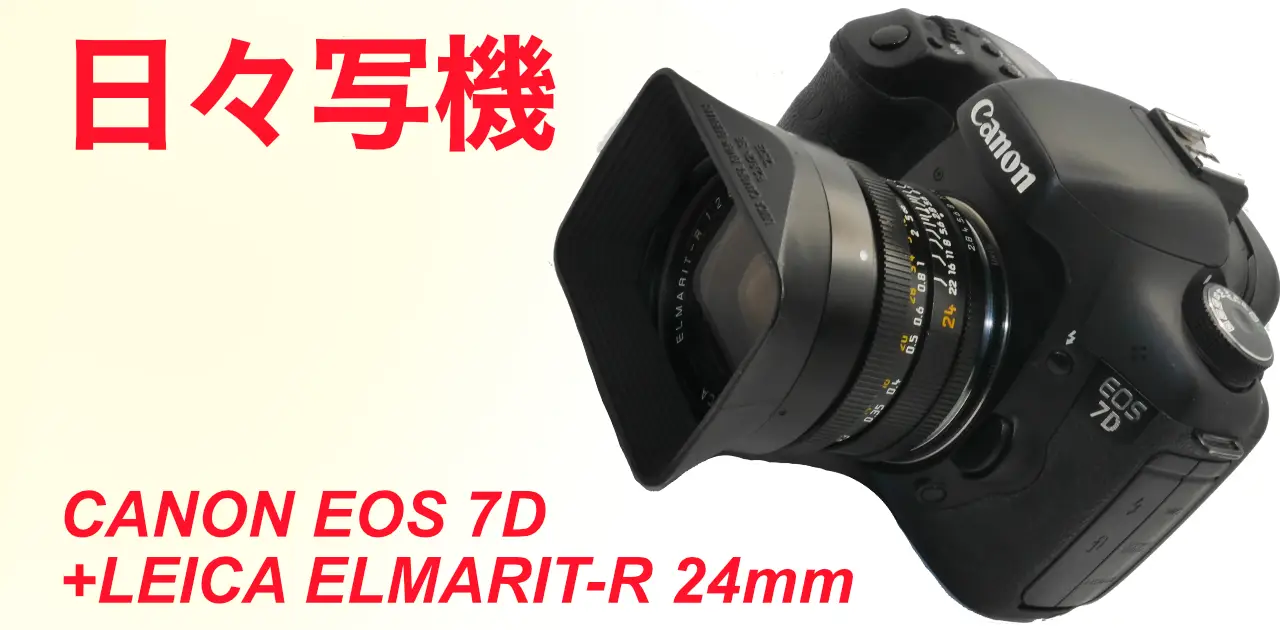
A short report on photos taken with a Canon EOS 7D and a Leica Elmarit R 24mm f/2.8 lens connected via an EF-R mount adapter.
- Please see the disclaimer regarding advertising here.
- Italicized links in the text are advertisement links that take you to other sites.
- If you find any images used on this site problematic, please contact us via the comments or inquiry form, either as the rights holder or their representative. We will review the matter and take appropriate action.
About the photo examples
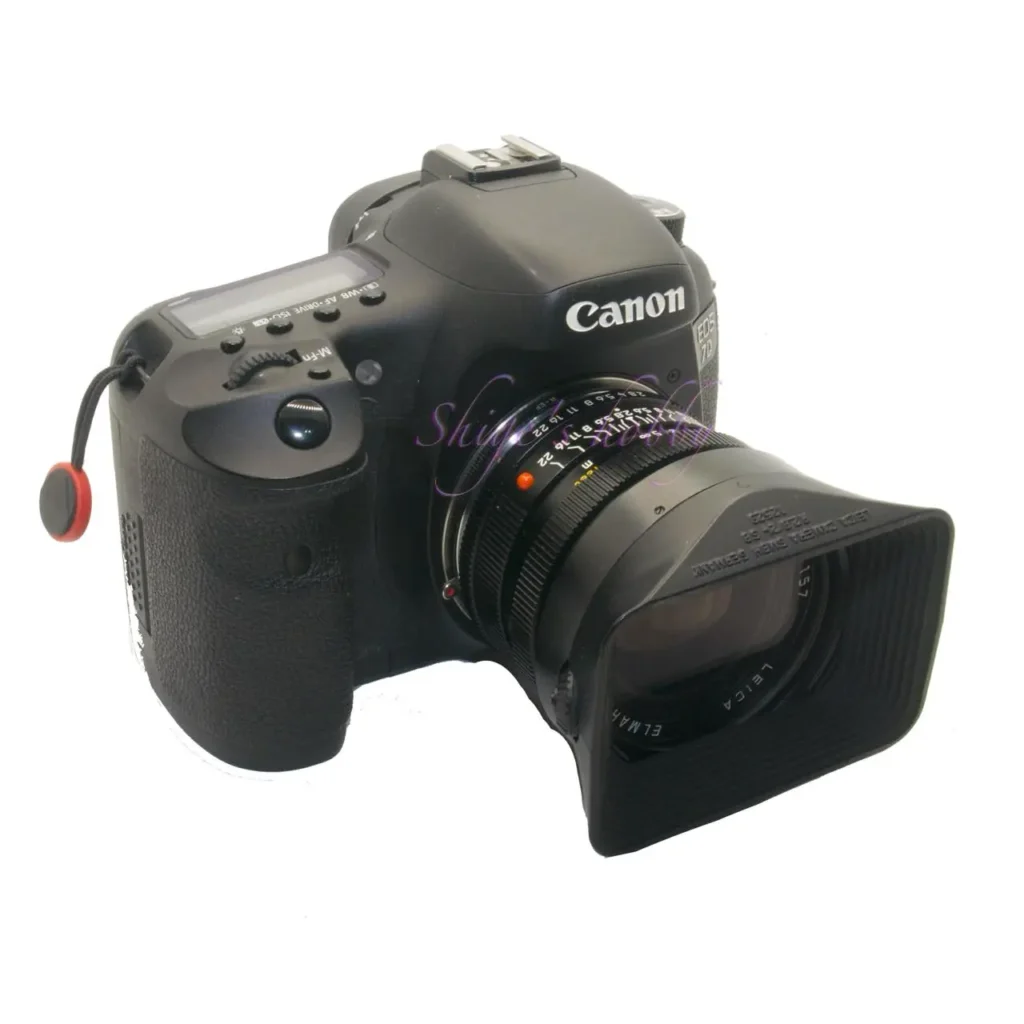
When mounted on a Canon EOS 7D, the focal length of the ELMARIT R 24mm lens becomes equivalent to 38mm (24mm x 1.6), depending on the camera’s sensor size. This results in an ambiguous angle of view, making it a slightly narrow wide-angle lens or a slightly wide standard lens. The minimum focusing distance is 0.3 meters, a standard value for Leica R-mount lenses. This allows for reasonably close-up shots of subjects. However, at a focal length of 40 mm, a significant portion of the image is included in the frame, requiring attention to both the main subject and the surrounding areas.
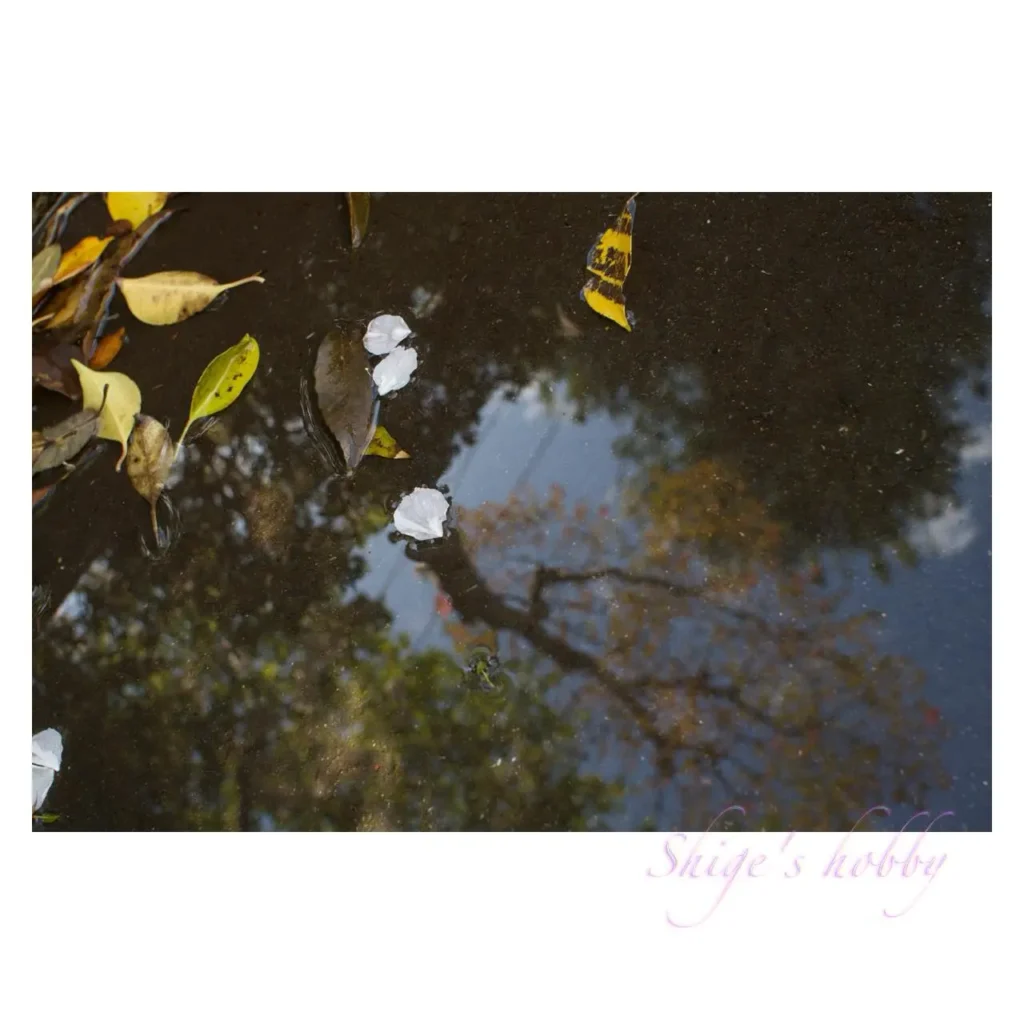
Since the shooting day was sunny with strong sunlight, all sample images were taken at F5.6, two stops down from the widest aperture. Because this is a wide-angle lens, it can be difficult to confirm the focus point when mounted on a digital SLR camera and shooting at the widest aperture. This is due to the compatibility between the Canon EOS 7D’s viewfinder and the photographer’s eyesight. While there are virtually no image quality issues at the widest aperture of F2.8, stopping down to F5.6 improves resolution, even at the edges of the image.
For a wide-angle lens, the bokeh in the foreground and background is pleasant, eliminating the need to worry about the background. Furthermore, the first and second example images were shot against the light. The first image shows minimal flare, and the second image exhibits refined ghosting. This makes it a lens that allows photographers to focus on objects in the background.
It is believed that this lens is based on a Minolta design, as Minolta is renowned for its attention to detail in lens bokeh. Although the lens was designed in 1974, its serial number in the 3.83 million range suggests that it was manufactured in 1998, which is relatively new for this type of lens. Therefore, the coating is likely more advanced than that of older lenses.


About the LEICA ELMARIT R 24mm
The LEICA ELMARIT R 24mm lens is a manual focus wide-angle lens for the Leica R mount, released in 1974.
The Leica R mount has a relatively long flange back distance of 47.4mm compared to other SLR cameras. Therefore, during the era when SLR cameras were dominant, EF-R mount adapters were manufactured to convert it to the Canon EF mount. Now that mirrorless cameras are the mainstream, mount adapters compatible with almost all mirrorless cameras are available. Furthermore, for mirrorless cameras, focal reducer mount adapters are also available to shorten the focal length when used with APS-C size sensors.
This lens cannot be used with larger sensor-sized cameras such as the EOS-1D, EOS-1Ds, and EOS-1DX series, resulting in a camera error 20 (Err.20) when the shutter is released.
For more details about the lens, please see the link below.
About the Canon EOS 7D
For more details about the camera, please see the link below.
The Canon EOS 7D, released in 2009, is a digital SLR camera equipped with an 18-megapixel APS-C size sensor. It features the 8 frames per second high-speed continuous shooting function, a feature previously exclusive to the EOS-1D series, making it a popular choice among amateur photographers, particularly those specializing in bird photography.
As a 17-year-old camera with a large initial supply, it’s relatively inexpensive for an EOS digital SLR and readily available on the used market. However, due to its high-speed continuous shooting capabilities, many used cameras have heavily used shutters. Therefore, it’s recommended to check the shutter count before purchasing, if possible. Instructions for checking the shutter count are available in “CANON EOS 7D・Shige’s hobby”.
To attach a Leica R-mount lens to a Canon EOS mount camera, a thin EF-R mount adapter is required. EF-R mount adapters are available from many manufacturers, with a wide range of prices. Therefore, when using a lesser-known, low-priced mount adapter, you need to check that the camera and lens connect smoothly. If you feel resistance when connecting, do not force it in. The worst-case scenario is that it inserts smoothly but becomes impossible to remove. This situation rarely occurs, but caution is advised with inexpensive products.
Reference links
- CANON EOS 7D・Shige’s hobby
- LEICA ELMARIT R 24mm・Shige’s hobby
- CANON EOS 7D・CANON Official page
寄付のお願い・Request for donations
Affiliate links
- CANON EOS 7D・Ads by Yahoo Shopping
- CANON EOS 7D・Ads by Amazon
- CANON EOS 7D・Ads by Rakuten

Be First to Comment