
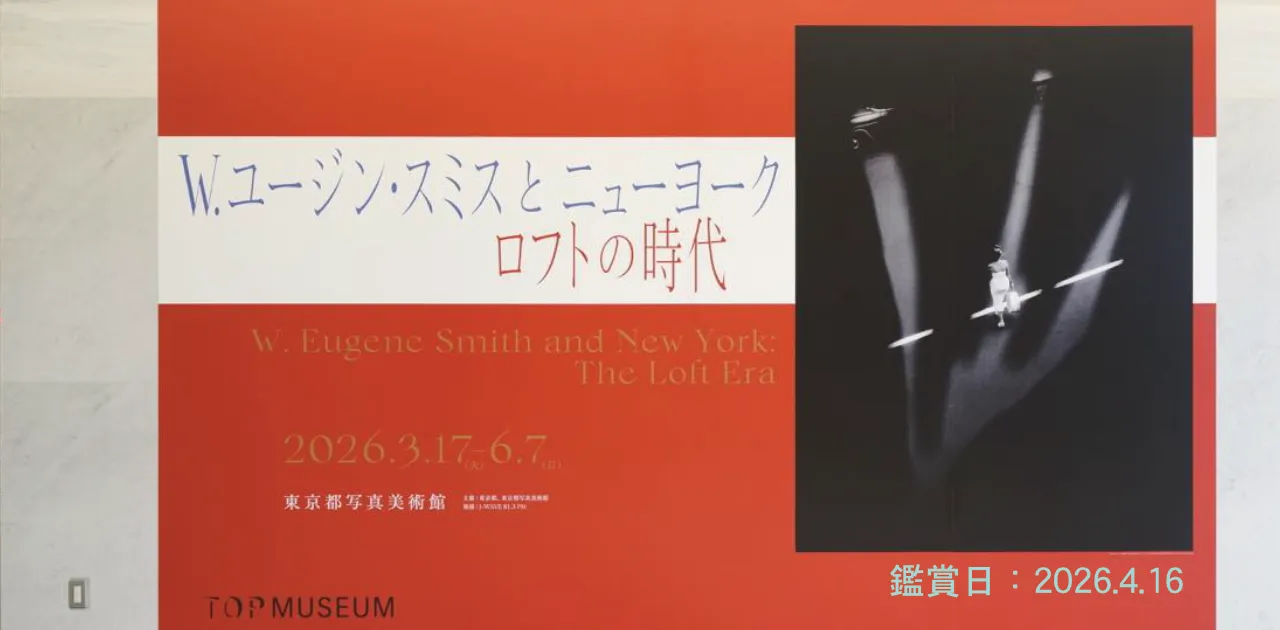
My impressions of the “W. Eugene Smith and the New York Loft Era” exhibition at the Tokyo Photographic Art Museum in Ebisu, Tokyo, in April 2026.
- Please see the disclaimer regarding advertising here.
- Italicized links in the text are advertisement links that take you to other sites.
- If you find any images used on this site problematic, please contact us via the comments or inquiry form, either as the rights holder or their representative. We will review the matter and take appropriate action.
Table of contents

Exhibition Overview
- “W. Eugene Smith and the New York Loft Era”
- April 11th (Sat) – June 7th (Sun), 2026
- Tokyo Photographic Art Museum (TOP MUSEUM)
- Admission: 700 yen for general admission, one free entry with a valid “Gurutto Pass”
While close-up photography of individual pieces is prohibited, photography of multiple pieces together is permitted within the museum.
This exhibition consists of works from the collection of the Tokyo Photographic Art Museum.
The exhibition is structured as follows:
- イントロダクション /Introduction
- 第1章 偉大な都市 /Chapter 1: The Great City
- 第2章 ロフトの時代 /Chapter 2: Loft Era
- 第3章 展覧会「Let Truth Be the Prejudice」 /Chapter 3:Let Truth Be the Prejudice
- 第4章 水俣 -報道と芸術の融合 /Chapter 4: Minamata -The Fusion of Journalism and Art
Impression: “A monochrome world seen in a space filled with jazz music”
This is my first time closely examining the work of W. Eugene Smith.
Since I wasn’t familiar with him, I summarized the information I gathered from the exhibition description for my own reference. Smith was born in 1918 and began his career in photography at the age of 16, working as a photojournalist for a local newspaper. During World War II, he worked as a war photographer for a magazine, traveling to Saipan and Iwo Jima. He was seriously wounded in Okinawa in 1945, at the end of the war. After the war, he joined Magnum Photos in 1954. However, his health deteriorated, so he moved to New York in 1957. The theme of this exhibition, “The Loft Era,” is his time in New York, when he began interacting with painters and musicians. From 1969 onward, while involved in antiwar movements, he held his own retrospective exhibition, “Let Truth Be the Prejudice,” which toured to Tokyo in 1971. From 1971 to 1978, he photographed Minamata, raising worldwide awareness of Minamata disease. He passed away shortly thereafter, in 1978.
The works from the loft era impressed me most because they seem to represent the period when the artist was most freely expressive. The shadows of the monochrome images on display made me feel as if the subjects’ emotions were captured.
Various kinds of music, including jazz by Miles Davis and Thelonious Monk, played throughout the venue. Combined with the exhibits that recreated the artist’s life in the area, they created a wonderful atmosphere.

W. Eugene Smith Archive
(From the collection of the Center for Creative Photography, University of Arizona)
When researching Smith’s time at LOFT, one sometimes encounters a website for a publication published in 2009 called “JAZZ LOFT PROJECT,” which featured Smith’s photographs. However, this website ceased updates in 2012, and as of 2026, the domain is for sale. The book is available for purchase through Amazon and various bookstores’ import services, and used copies are also available.
Smith’s works are held in the collections of institutions such as the Tokyo Photographic Art Museum, the Tokyo Fuji Art Museum, and the Kiyosato Photo Art Museum, and exhibitions of his work are held throughout Japan.
As a camera enthusiast, I’d like to introduce the cameras used by Smith and his wife, Irene, in Minamata. They were on display.
The caption states that Irene used the FUJICA ST701, which was fitted with a “KOMURANON 24mm F/2.5” M42 mount lens. The Nikon F, which the caption states was used by both Irene and Smith, was fitted with a Nikkor-N Auto 24mm f/2.8 lens. The flash on the right is a general-purpose “National 203.”
Both lenses are 24mm wide-angle, and the cameras are standard mechanical SLRs that were commonly sold at the time.

Reference links
- W. Eugene Smith and the New York Loft Era
- 東京都写真美術館(TOP MUSEUM)
- Magnum Photos / W. Eugene Smith
- W. Eugene Smith Memorial Fund
- Eugene Smith Exhibition Dates: March 20, 2022 (Sun) – June 5, 2022 (Sun) Tokyo Fuji Art Museum
- JAZZ LOFT PROJECT・Internet Archive
- Let Truth Be the Prejudice Exhibition Catalogue by W. Eugene Smith・Nitate-sha (Used Bookstore)
- Kiyosato Photo Art Museum
寄付のお願い・Request for donations
Affiliate links
- Tokyo Photographic Art Museum・Ads by Amazon
- Tokyo Photographic Art Museum・Ads by Rakuten
- W. Eugene Smith・Ads by Amazon

Photo Equipment
- SONY DSC-RX1
- CANON EOS 7D +SUPER ELMARIT R 15mm F2.8
Update history
- 2026.4.24
Be First to Comment