

A review and sample photos of the SONY 50mm F1.4 large-aperture standard lens used with the SONY A900.
- Please see the disclaimer regarding advertising here.
- Italicized links in the text are advertisement links that take you to other sites.
- If you find any images used on this site problematic, please contact us via the comments or inquiry form, either as the rights holder or their representative. We will review the matter and take appropriate action.
Table of contents

Gallery
The following cameras were used to take the sample photos:
Review


1.Overview
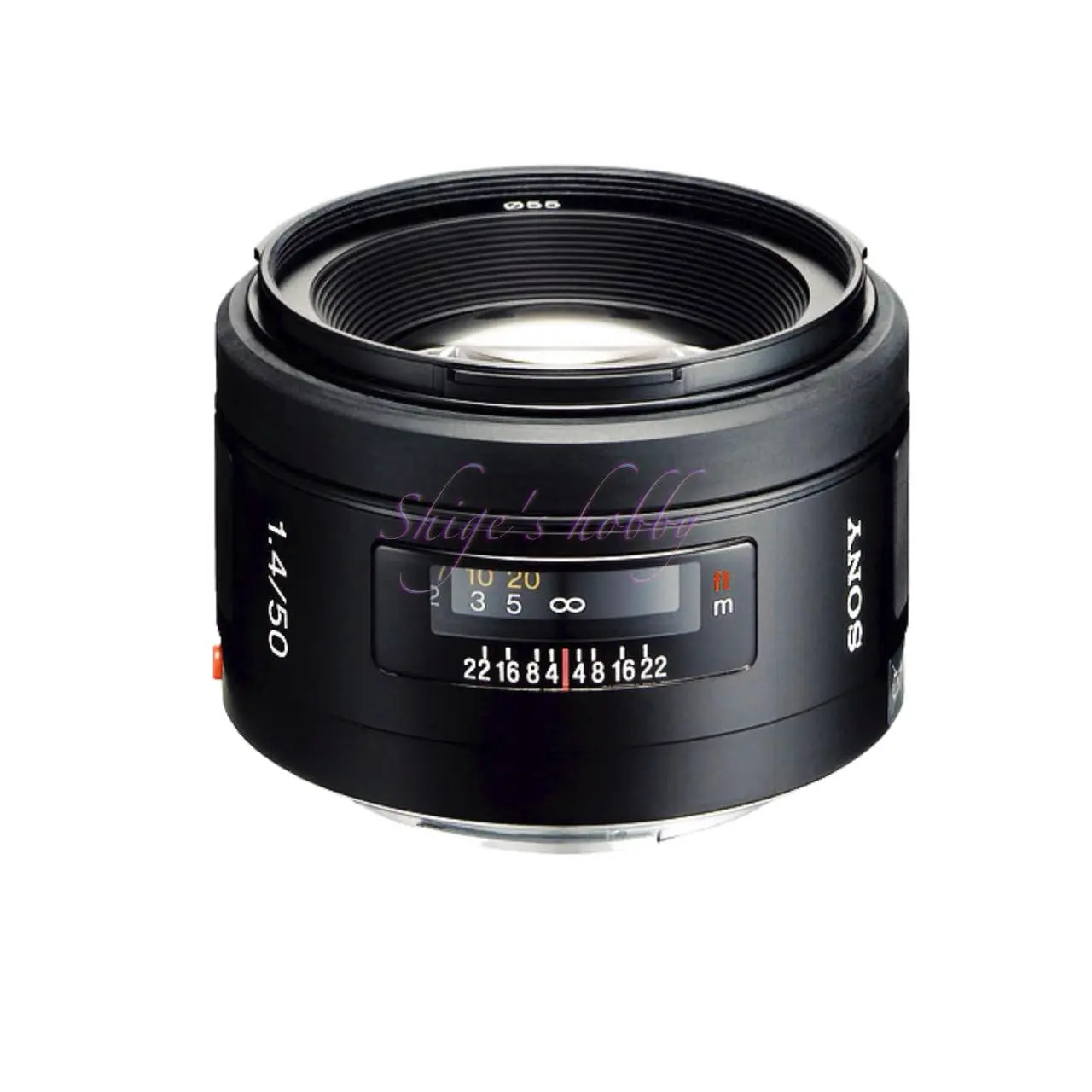
The SONY 50mm F1.4 is a large-aperture, wide-angle autofocus lens released by Sony in 2006.
This lens is simply a Sony remake of the AF 50mm F1.4 (New) released in 1998 during the MINOLTA era; there are no functional changes to the lens.
It does not feature the focus hold button that is featured on some (New) lenses.
It is possible that the newer model has better lens coating, but there are no clear sources available on this.
The main specifications of this lens are as follows,with details listed in the specifications table.
- Lens Construction: 6 groups, 7 elements
- Minimum focusing distance: 0.45m
- Filter diameter: 55mm (New and Sony)
- Dedicated bayonet-type cylindrical hood (New and Sony)
- Distance encoder not supported
The oldest Old model has a 49mm filter diameter and a built-in hood, and the lens barrel structure is different, but the lens construction is the same as the New Sony model.
This lens is a Sony A (α) mount lens, so the aperture is set on the camera. The lens has a minimum focusing distance of 0.45m, which is not particularly distinctive for a standard lens.
It does not have a lens motor, and the autofocus is driven by the camera’s driving force.
As it does not use the SSM (Ultrasonic Motor) / SAM (Smooth AF Motor) motors that are mounted on the lens itself, as used in later Minolta and some Sony lenses, there may be restrictions when using it with a Sony α mirrorless camera via a genuine Sony mount adapter.
The restrictions are summarized in the “Specifications, Considerations, etc.” section.
2.Usability
The SONY 50mm F1.4 lens has a double Gauss lens configuration, typical of standard lenses from the 1980s, and its performance is more than adequate for use with 35mm film. Looking at the results on the 24-megapixel 35mm full-frame sensor, I’m not disappointed.
As an aside, this lens was released over three generations during the MINOLTA era. I first bought the old MINOLTA, then the new MINOLTA, so I sold the old one. I bought the Sony version without doing much research, expecting it to have a D-type lens, but it turned out to be no different from the new one.
Even during the Sony era, it was an inexpensive lens, so I bought them without much thought, and as a result, I’ve now acquired them all.
The true joy of a large-aperture lens is its rendering near maximum aperture, which rapidly blurs from the focal plane, as shown in the example below. Stopping down to F5.6, the overall image quality tightens and becomes easier to use.
The example photo was taken using autofocus, and although the focus may be slightly off from the flower on the left, the image produced at full aperture is softer.


Looking at the sample images taken at F2.8, F3.2, and F10, we can see that sufficient resolution is achieved by stopping down the aperture a little.
The fourth photo is a result of a shoot with the new lens from the MINOLTA era, and the difference from the Sony version is not clear.
The fifth photo is a result of a shoot with the early MINOLTA old model. At 49mm, the filter frame is 6mm smaller than the new and Sony versions, but looking at the F2.8 result, there is no vignetting and the change to 55mm for the new model is presumably to match the size with other new type lenses.
When attached to the Sony α900 A-mount digital camera, autofocus is possible and I was satisfied with the focusing speed and accuracy.
Also, even at close range, as long as the subject is clear, the autofocus does not hesitate and focuses precisely.
The lens is a standard size for a standard lens, and even when paired with the Sony α900, it weighs around 1kg, which is standard for an SLR camera system.
3.Summary
To summarize the SONY 50mm F1.4, it is a large-aperture standard lens that can be used with autofocus. While rendering is a little soft near the maximum aperture, sharpness improves at around F4 and remains sharp even when stopped down.
The lens construction is similar between the SONY and MINOLTA versions, and while there may be differences in coating, you should hardly notice any difference in practice, so it’s best to choose based on your preference for brand and retail price.
The Sony Planar T* 50mm F1.4 ZA SSM SAL50F14Z is a completely new lens design.
Specifications, considerations, etc.
The first release was the Alpha mount version in 1985, which was changed to the (New) version in 1998 with a revised exterior, but was not updated to the (D) version with a distance encoder for use with flash control. The (New) version was also retained when released by Sony. The final A-mount version, the PLANAR 50mm F1.4, was released in 2013 under the CARL ZEISS brand.
The evolution of the MINOLTA/SONY AF 50mm F1.4
- Y1985 Minolta AF 50mm F/1.4 Old
- Y1998 Minolta AF 50mm F/1.4 New
- Y2006 SONY AF 50mm F/1.4
- Y2013 SONY Planar T* 50mm F1.4 ZA SSM
The A-mount was the world’s first commercially available autofocus interchangeable lens camera mount, but early A-mounts used a motor in the camera body to drive the lens, and while the aperture was controlled from the camera, the actual aperture mechanism was operated mechanically with a lever.
Because the flange focal distance between other companies’ SLR cameras was only a few millimeters shorter, it was difficult to incorporate a mechanism to drive the aperture, even if the focus mechanism could be moved. As a result, no mount adapters were made to allow A-mount lenses to be used with other companies’ SLR cameras.
With the advent of mirrorless cameras, the difference in flange focal distance between SLR cameras was reduced to around 20 mm, and Sony released a mount adapter to allow genuine A-mount lenses to be used with E-mount cameras. There are five types of mount adapters, the features of which are briefly described below.
- LA-EA1: Aperture control + limited autofocus for APS-C sensors
- LA-EA2: Aperture control + autofocus for APS-C sensors (with translucent mirror)
- LA-EA3: Aperture control + limited autofocus for 35mm full-frame sensors
- LA-EA4: Aperture control + autofocus for 35mm full-frame sensors (with translucent mirror)
- LA-EA5: Aperture control + autofocus + camera limit for 35mm full-frame sensors
If you want to use older A (α) mount lenses like the MINOLTA AF 28mm F2 with autofocus, there are two options: for older E-mount cameras, use the LA-EA4, which is equipped with a translucent mirror; for newer cameras like the α7R IV, α7 IV, α1, α6600 and later, use the LA-EA5, which allows you to use autofocus with all A (α) mount lenses.
Sony Lens Compatibility Information
The above is a site where you can select the body and lens you want to use, and then it will show you what restrictions apply to that combination. However, this site doesn’t have a list, making it difficult to understand.
The autofocus notation clearly states if the camera is not compatible, but is silent if it is compatible.
| Image sensor size | AF compatible E-mount camera | Supports image plane phase detection AF with SSM/SAM lenses | Supports focal plane phase detection AF with lenses without a motor (SSM/SAM) | |
| LA-EA1 | APS-C | × | × | × |
| LA-EA2 * | APS-C | △ | × | × |
| LA-EA3 | 35mm full frame | SSM/SAM lenses only | × | × |
| LA-EA4 * | 35mm full frame | △ | × | × |
| LA-EA5 | 35mm full frame | SSM/SAM lenses only | α7 II, α7R II, α6300, α6500, α7 III, α7R III, α7R IV, α6100, α6400, α6600, α9, α9 II, α7S III, α7C | α7RⅣ, α7Ⅳ, α1, α6600, and newer cameras |
It may be possible to make an A (α) mount adapter for other companies’ mirrorless cameras, but with the aforementioned A (α) mount adapters for the E-mount already available, it is unlikely that any company would be so bold as to make an A (α) mount adapter, which requires complex mechanisms and high development costs, for other companies’ cameras that are unlikely to sell very well.
As an aside, the reason there are so many EF mount adapters for mirrorless cameras from various manufacturers is because the hurdle for product development is low – both aperture and focus are electronically controlled, so as long as there is ROM to convert the control commands, all that’s left to do is match the mount shape to create a mount adapter; and because the EF mount has historically had a large market share, so the market is flooded with used lenses.
For the A-mount, Sony released the PLANR T* 50mm F1.4 ZA under the CARL ZEISS brand in 2013. Compared to the AF 50mm F1.4 from 2006, the lens is about twice as long and heavy, and its diameter is one size larger (from 65.5mm to 81mm), making it an overall larger lens.
The increase in weight in particular is due to the larger lens diameter, the increased number of elements, and the inclusion of an ultrasonic motor in the lens.
Looking at the specifications, such as increased peripheral illumination due to the larger aperture and improved image flatness due to the aspherical lens element, it seems like a high-performance lens, and one I would like to try, but I didn’t have an A-mount body when used prices were low, so I never actually got around to purchasing one and using it.
| lens name | AF 50mm F1.4 | 50mm ZA SSM |
| Focal length | 50 | 50 |
| 35mm equivalent focal length (mm) | 75 | 75 |
| Max aperture | 1.4 | 1.4 |
| Min aperture | 22 | 22 |
| Leaf blade | 7 | 9 |
| Lens Construction | 7 elements in 6 groups | 8 elements in 5 groups |
| Min distance(m) | 0.45 | 0.45 |
| Lens length(mm) | 38.5 | 72 |
| Max diameter(mm) | 65.5 | 81 |
| Filter Size(mm) | 49 | 72 |
| Weight(g)(lens only) | 235 | 518 |
| Lens hood | Bayonet type Clyindrical | Bayonet type Clyindrical |
| Lens mount | A-mount | A-mount |
| Release date | 1985(old) 1998(New) 2006(Sony) | 2013 |
Reference links
- 50mm F1.4・SONY lens official page
- Sony announces release dates for α lenses and accessories・Degi-came watch
- AF 50mm F1.4・Lens.DB
- AF 50mm F1.7・Lens.DB
- Carl Zeiss PLANAR T* 50mm F/1.4 ZA SSM [SAL50F14Z]・SONY official page
寄付のお願い・Request for donations
Affiliate links
- SONY LA-EA*・Ads by Amazon
- SONY LA-EA5・Ads by Amazon
- SONY α900(A900)・Ads by Amazon
- SONY α900(A900)・Ads by Rakuten
- SONY 50mm F1.4・Ads by Amazon
- MINOLTA 50mm F1.4・Ads by Amazon
- ソニー Planar T* 50mm F1.4 ZA SSM SAL50F14Z・Ads by Amazon

Update history
- 2026.1.31: Two multi-split locations, No.2 and No.4 used
Be First to Comment