
Last updated on 2026-05-04
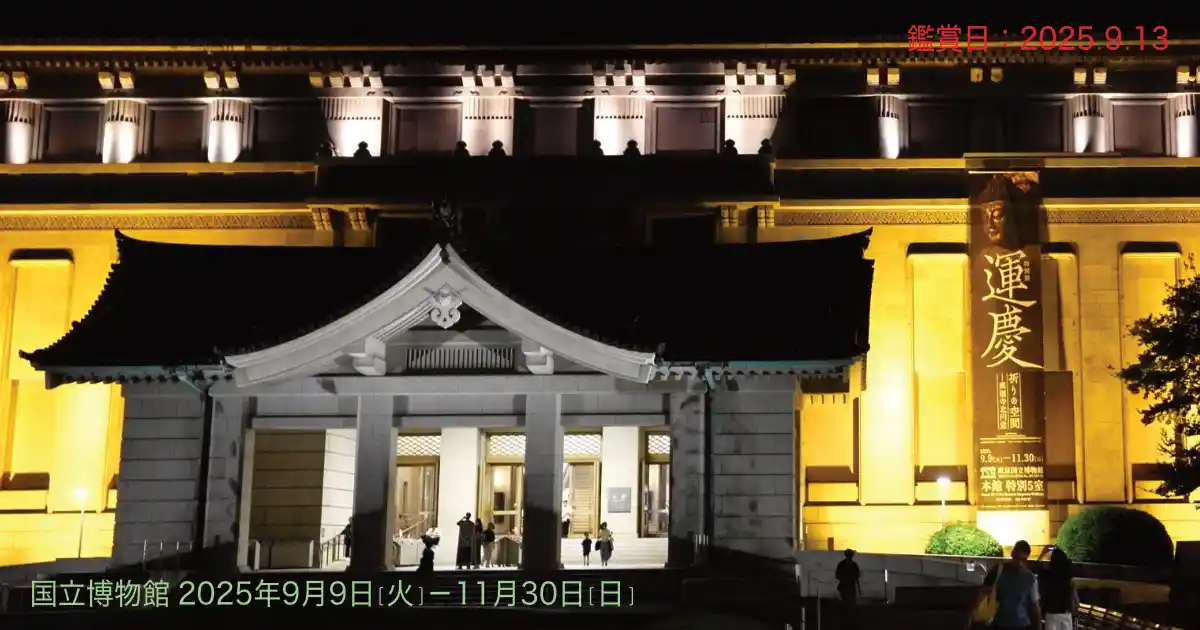
My impressions of the “Unkei: A Space of Prayer – Kofuku-ji Temple’s North Octagonal Hall” exhibition at the Tokyo National Museum, which I viewed on September 13, 2025.
- Please see the disclaimer regarding advertising here.
- Italicized links in the text are advertisement links that take you to other sites.
- If you find any images used on this site problematic, please contact us via the comments or inquiry form, either as the rights holder or their representative. We will review the matter and take appropriate action.
Table of contents
- Exhibition Overview
- My impression
- Kofuku-ji Temple 2013
- Unkei Exhibition 2017
- Gallery
- Reference links
Exhibition Overview
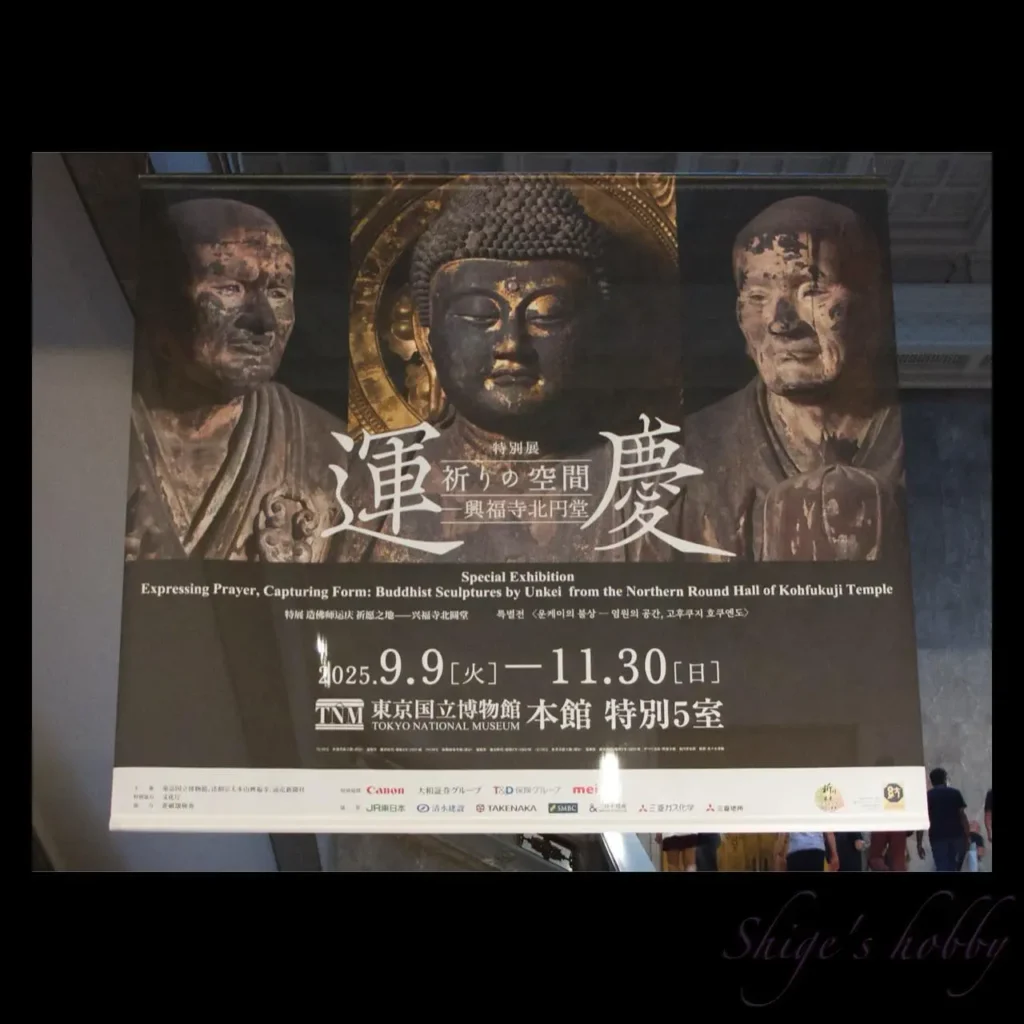
- Exhibition Title: Special Exhibition “Unkei: A Space of Prayer – Kofuku-ji Temple’s North Octagonal Hall”
- Dates: September 9, 2025 – November 30, 2025
- Location: Tokyo National Museum, Main Building, Special Exhibition Room 5
- [Notice of Extended Opening Hours]
- Opening hours will be extended until 8:00 PM every Friday and Saturday, and on September 14th (Sun), October 12th (Sun), November 2nd (Sun), and November 23rd (Sun) (last entry at 7:30 PM).
The Buddha who came to Tokyo for this exhibition
- Seated statue of Maitreya Buddha (housed in the North Octagonal Hall of Kofuku-ji Temple)
- Standing statue of Asanga Bodhisattva (housed in the North Octagonal Hall of Kofuku-ji Temple)
- Standing statue of Vasubandhu Bodhisattva (housed in the North Octagonal Hall of Kofuku-ji Temple)
- Standing statues of the Four Heavenly Kings (Dhritarashtra – housed in the Central Golden Hall of Kofuku-ji Temple)
- Standing statues of the Four Heavenly Kings (Virudhaka – housed in the Central Golden Hall of Kofuku-ji Temple)
- Standing statues of the Four Heavenly Kings (Virupaksha – housed in the Central Golden Hall of Kofuku-ji Temple)
- Standing statues of the Four Heavenly Kings (Vaiśravaṇa – housed in the Central Golden Hall of Kofuku-ji Temple)
My impression: “Memories connecting Tokyo and Nara”
This exhibition features Buddhist statues arranged as they are inside the Hokuen-do Hall of Kofuku-ji Temple in Nara. The statues are displayed in the Special Room 5 of the museum.
Of the seven statues enshrined there, the three central figures are in the Hokuen-do Hall, and the Four Heavenly Kings statues are in the Chūkon-dō Hall, both of which are in Kofuku-ji Temple.
The key point is that you can see the statues in their original locations, despite them being housed in different halls, all within a single space.
There are various theories about which hall the Four Heavenly Kings statues were originally housed in, including the Nanen-do Hall and the Hokuen-do Hall. This exhibition presents an “if” scenario in which these seven statues are displayed in the Hokuen-do Hall. A similar attempt was made in the 2017 Unkei Exhibition; however, there are differences this time, which are explained on the “Unkei Exhibition 2017” page.
First, when viewing the three statues in the North Octagonal Hall of the actual temple, the nine statues are grouped together, creating a slight distance between the central three and the others. This time, however, the Maitreya Buddha seated statue, the Asanga Bodhisattva standing statue, and the Vasubandhu Bodhisattva standing statue are closer together, allowing for a more detailed appreciation of the statues.
Viewing the three statues from the front—the Maitreya Buddha seated statue, the Asanga Bodhisattva standing statue, and the Vasubandhu Bodhisattva standing statue—brought back memories of seeing them in the temple. Turning left, the light reflecting from the Vasubandhu Bodhisattva statue’s inlay caught the eye. Moving to the back, all three silhouettes came into view simultaneously, clearly distinguishing the serene Asanga Bodhisattva and the powerful Vasubandhu Bodhisattva from the rear. Furthermore, the Maitreya Buddha’s halo has been removed, giving the statue a different appearance than when it was viewed in the temple.
The Four Heavenly Kings statues in the Central Golden Hall of Kofuku-ji Temple are displayed independently, allowing for a full 360-degree view of each statue.
The first statue you see upon entering is Zochoten, who gives the most youthful impression. The three faces on his chest and abdomen add to his otherworldly appearance. Further inside stands Komokuten, whose golden hues are beautifully reflected by the lighting. His pose, with his hand on his twisted waist, is striking. To his right is Tamonten, whose pose holding a treasure pagoda with his arm outstretched is impressive. Some visitors have even been seen imitating his pose. Near the exit is Jikokuten, who exudes a dignified, elder-like presence.
As I gazed upon the four statues, vague memories of the past began to resurface.
While the exhibition’s lighting was meticulously designed to create an excellent viewing environment, I was slightly disappointed that the entrance to the venue was located near the Zochoten statue. This meant that visitors had to view the statues from a diagonal, downward angle.
It may have been difficult due to the venue’s layout, but I believe that facing the entrance toward the front of the seated Maitreya Buddha statue would have provided a more authentic viewing experience.
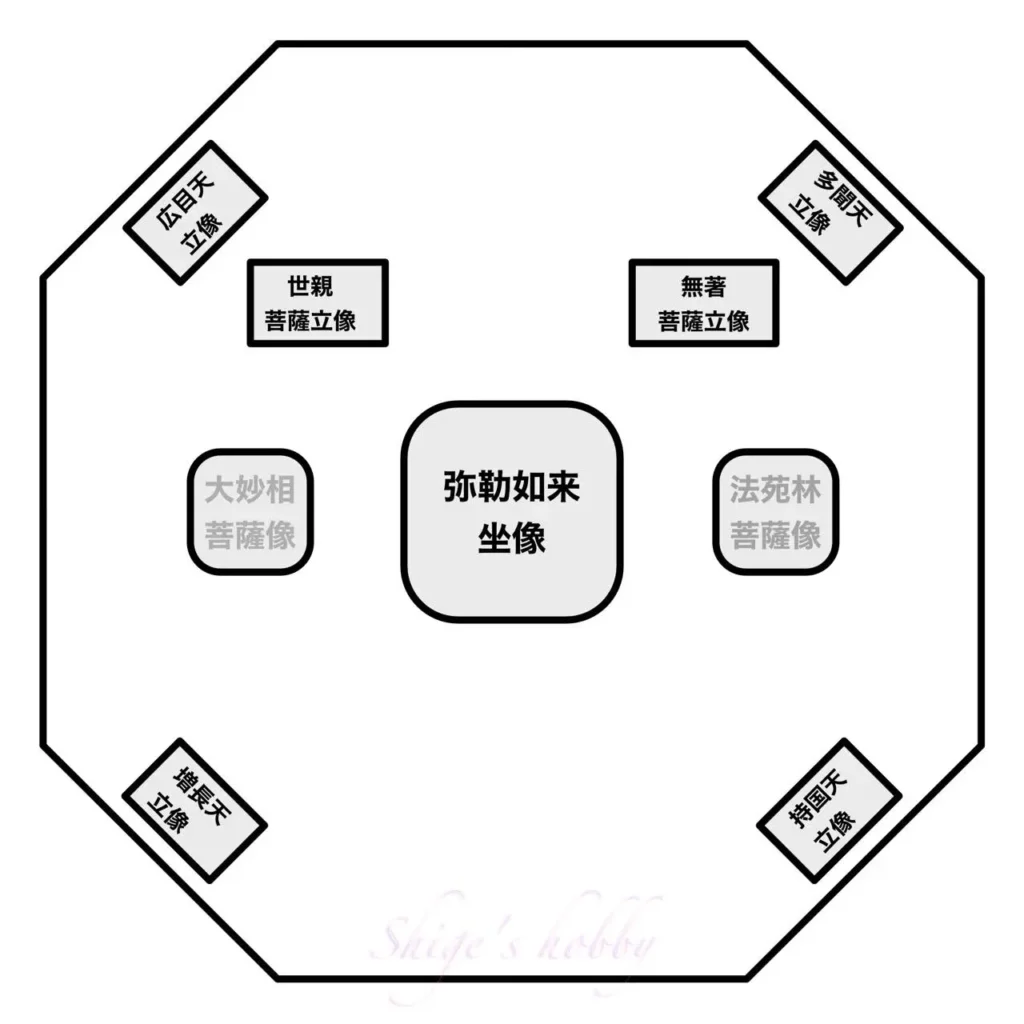
The Hokuen-do Hall of Kofuku-ji Temple in Nara houses nine Buddha statues, as shown in the diagram below. Six of these statues were not on display this time: the Daimyoso Bodhisattva and Hoenrin Bodhisattva statues, both of which were created during the Muromachi period; the Heian period dry lacquer statue; and the National Treasure Four Heavenly Kings statues. Furthermore, the halo behind the seated Maitreya Buddha statue was removed and is not on display.
Kofuku-ji Temple 2013
I visited the North Octagonal Hall in Nara in 2013. Since this exhibition took place in 2025, 12 years had passed—a full cycle of the Chinese zodiac—and my memories of that time had faded. However, thanks to the exhibition, which recreated the hall, my memories came flooding back.
The South Octagonal Hall is usually open to the public on October 17 every year, and the North Octagonal Hall is open in the spring (late April to early May) and fall (early September to late November).
In 2013, the year I visited, there was a special event commemorating the 1,200th anniversary of the founding of the South Octagonal Hall, during which both halls were open. I drove from the Kantō region to Nara. The distance from Kanto to Nara is about 450 km. I left my hotel at 7:00 a.m. and arrived at Kofuku-ji Temple around 2:00 p.m. I viewed the South and North Octagonal Halls that day and visited the Kofuku-ji Treasure Hall and other attractions the following day.
The National Treasure Four Heavenly Kings statues, which are currently on display, were housed in the Nan-en-do Hall in 2013. I remember seeing them with the large Fuku Kensaku Kannon statue. The combination of the statues in the Nan-en-do Hall was impressive.
In 2018, these Four Heavenly Kings statues were moved to the newly completed Chū-kon-do Hall, where they are on permanent display. Additionally, the Four Heavenly Kings statues that were housed in the temporary Kondo Hall (now the lecture hall) have been moved to the Nan-en-do Hall.
For the most up-to-date information on the location of the Four Heavenly Kings statues, please refer to the linked article, “Topics — The Story of the Four Heavenly Kings Statues at Kōfuku-ji Temple: The Nan-en-do Hall Statues and Temporary Lecture Hall Statues Move [3/10/2018].”
Unkei Exhibition 2017
The standing statues of Bodhisattva Muchaku and Bodhisattva Seshin from the North Octagonal Hall and the Four Heavenly Kings from the Central Golden Hall were exhibited in Tokyo for the “Unkei Exhibition” in 2017.
That exhibition featured a similar concept to this one, exploring what the Four Heavenly Kings of the North Octagonal Hall would have looked like in the Central Golden Hall.
Both exhibitions followed the arrangement of the North Octagonal Hall. However, there are two differences between this exhibition and the 2017 exhibition. First, the seated statue of Maitreya Buddha, positioned between Bodhisattva Muchaku and Bodhisattva Seshin, was not exhibited in Tokyo in 2017 and was only shown as a photograph. Second, the standing statues of the Four Heavenly Kings from the Central Golden Hall were exhibited under their old names.
The names of the three statues of the Four Heavenly Kings housed in the Central Golden Hall were changed in 2018. Therefore, although the names are the same as in the 2025 exhibition, the statues on display are different.
List of changes to the names of the Four Heavenly Kings statues in 2018:
- Jikokuten (2018 name change) → Former name: Komokuten
- Zochoten (2018 name change) → Former name: Jikokuten
- Komokuten (2018 name change) → Former name: Zochoten
- Tamonten (no change).
Gallery
Reference links
- Special Exhibition “Unkei: A Space of Prayer – Kofuku-ji Temple’s North Octagonal Hall”・National Museum official page
- Related events for the special exhibition “Unkei: A Space of Prayer – Kofuku-ji Temple’s North Octagonal Hall”・National Museum official page
- Kofuku-ji Temple, the head temple of the Hossō sect.・Official page
- Topics ~ The story of the Four Heavenly Kings statues at Kofuku-ji Temple: The statues in the Southern Octagonal Hall and the temporary lecture hall have been moved [2018.3.10]・Daily Journal of Buddhist Contemplation
Affiliate links
- Kofuku-ji Temple・Ads by Amazon
- Kofuku-ji Temple, North Octagonal Hall・Ads by Amazon
- Unkei Buddha・Ads by Rakuten
- LEICA T typ701・Ads by Amazon
- SIGMA 20mm DG DN・Ads by Amazon
- PANASONIC LUMIX DMC-LX7・Ads by Amazon

Photo Equipment
- LEICA T typ701 +SIGMA 20mm DG DN
- PANASONIC LUMIX DMC-LX7
Update history
- 2025.9.15
Be First to Comment