
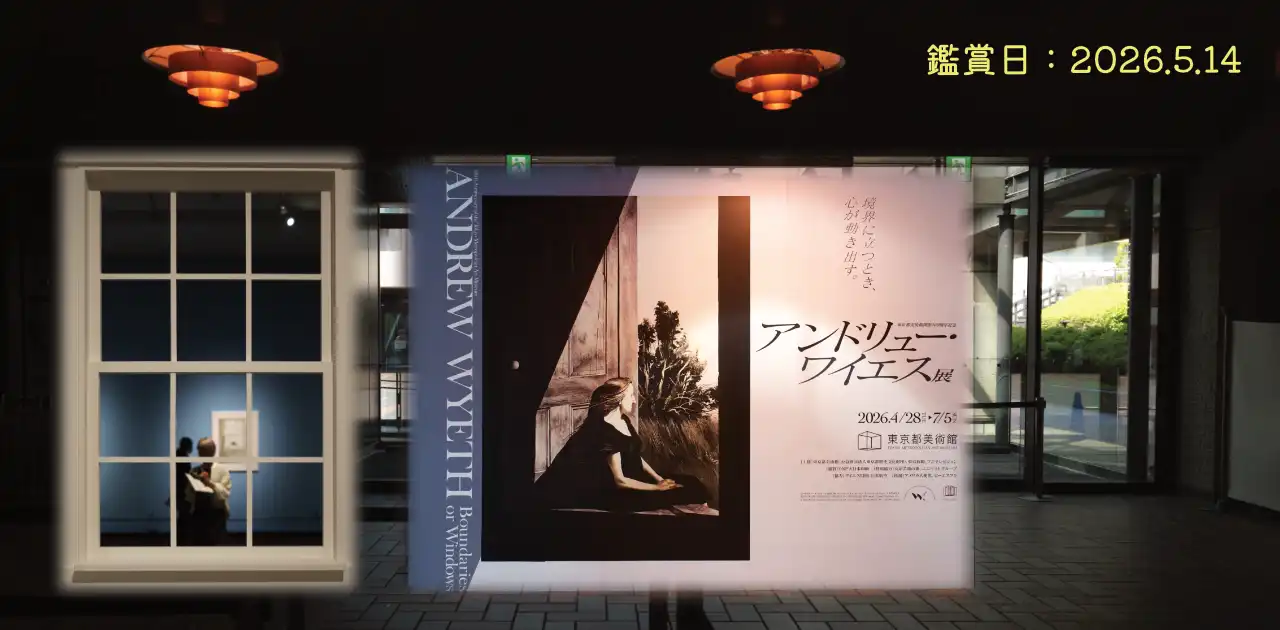
My impressions after viewing the “Andrew Wyeth Exhibition: Celebrating the 100th Anniversary of the Tokyo Metropolitan Art Museum” at the Tokyo Metropolitan Art Museum in Ueno, Tokyo, in May 2026.
- Please see the disclaimer regarding advertising here.
- Italicized links in the text are advertisement links that take you to other sites.
- If you find any images used on this site problematic, please contact us via the comments or inquiry form, either as the rights holder or their representative. We will review the matter and take appropriate action.
Table of contents
Exhibition Overview
- Exhibition Title: Andrew Wyeth Exhibition: Celebrating the 100th Anniversary of the Tokyo Metropolitan Art Museum
- Dates: April 28, 2026 (Tue) – July 5, 2026 (Sun)
- Hours: 9:30-17:30, Fridays until 20:00 (Last entry 30 minutes before closing)
- Closed: Mondays (Open on public holidays and with substitute holidays)
- Location: Tokyo Metropolitan Art Museum
- Admission Fee: 2,300 yen (General Admission)
Please note that JCB cards are not accepted at the Tokyo Metropolitan Art Museum ticket office. Tickets purchased at the ticket office are printed on thermal paper and include a QR code. Paper tickets are not provided.
The works exhibited in this exhibition are on loan from the following museums, companies, organizations, and individuals.
The National Academy of Design (New York); the Museum of Fine Arts, Boston; the Whitney Museum of American Art (New York); the Myron Kunin Collection (Minneapolis); the Addison Gallery (Phillips Academy); the Flint Museum of Art; the Narita Golf Club; the Unimat Group; the Delaware Museum of Art (Wilmington); the Philadelphia Museum of Art; Gallery Yuki Co., Ltd.; the Cummer Museum of Art (Jacksonville); the Farnsworth Museum of Art (Rockland); the Fukushima Prefectural Museum of Art; the Hulic Hotel Management Co., Ltd.; the Cleveland Museum of Art; the Menard Art Museum; the Philbrook Museum of Art (Tulsa); the Keisuikai Medical Corporation; the Aichi Prefectural Museum of Art (donated by Andrew and Mrs. Wyeth); the Sumitomo Mitsui Banking Corporation; and private collections.
After showing at the Tokyo Metropolitan Art Museum, where I saw it, the exhibition will travel to the Toyota Municipal Museum of Art in Aichi Prefecture from July 18, 2026, and then to the Abeno Harukas Museum in Osaka Prefecture from October 3, 2026.
The official catalog costs 3,300 yen (tax included) and measures 30 cm high, 23 cm wide, and 2 cm thick. Since the book does not have an ISBN, it is unclear whether it will be available through general distribution channels; sales may be limited to the venues themselves.
My impression: “The multifaceted appeal of Wyeth”
This text contains spoilers, including my impressions of the works in each chapter. If you want to experience the exhibition with a fresh perspective, please be aware of this.
The exhibition is divided into thematic chapters, rather than arranged chronologically.
- The painter Wyeth
- Light and Shadow
- A New England House – Olson House
- The breadth of the gaze
- Boundaries or windows
Chapter 1, “Wyeth the Painter,” opens with a self-portrait from the collection of the National Academy of Design. In the portrait, the artist wears a high-collared coat and has a determined gaze. He stands in a meadow reminiscent of early autumn. I felt that this work was an excellent choice as an entry point to the exhibition, building anticipation for what is to come.
The chapter introduces various facets of Wyeth’s work, allowing viewers to appreciate his diverse talents through surrealistic, symbolic, and mystical pieces.
The privately owned “Sand Dollar,” displayed at the end of the chapter, is named for the six-lobed pattern that resembles a fossilized sea urchin from the Paleozoic era. The melancholy expression of the depicted man, combined with the pattern, reminds me of the works of Hilma af Klint.

Chapter 2 features many landscape paintings. What I noticed here was the distinctive frames used in Wyeth’s works. The frame of “The Pine Cone Baron,” owned by the Fukushima Prefectural Museum of Art, is particularly striking, resembling scales with its diamond-shaped pattern. Since frames are supplementary to the exhibit, catalogs and other publications usually only show the artwork, unless the frame has historical value. Therefore, seeing the actual frames in a museum is one of the pleasures of the experience.
“Haymaking” still bears markings from the materials used to create it, including the notation “BOARD 059.” This suggests that Wyeth wasn’t as concerned with minute details as one might expect, revealing a slightly different side of his work compared to his self-portraits. “Napping,” owned by the Farnsworth Art Museum, depicts a cat, making it a must-see for cat lovers.
Chapter 3 occupies the entire first floor and displays a model of Olson House and 51 paintings. Most of the exhibited works are from the Marunuma Art Forest collection, but three works borrowed from overseas museums are displayed at key points in the exhibition.
The first piece borrowed from overseas is “The Blue Door,” from the Delaware Art Museum collection. It is located on the wall at the far end, viewed from the right side of the entrance after taking the elevator. While many of Wyeth’s works emphasize contrast and feature subdued colors, the depiction of light shining through the blue door is striking.
The use of red and blue as accents in several other pieces is also notable.
Further into the exhibition, in the middle of the display, is Christina Olson from the Myron Kunin Collection. This piece is featured on the exhibition’s flyers and signs. The shading of the figure and background in this work beautifully illustrates the charm and characteristics of Olson’s style.
Finally, The End of the Olson Family, from the Cleveland Museum of Art, is displayed alongside a study. While both works have the same composition, the Marunuma Art Forest study depicts almost only the house, perhaps to define its form. In contrast, “The End of the Olson Family” includes the sky in the background, allowing viewers to appreciate the final form of the work.
Chapters 4 and 5 are areas where photography of the artwork is permitted.
These chapters are connected by window designs, suggesting that they were conceived as a continuous space. The silence that descended when people disappeared from view through the windows was pleasant.

In Chapter 5, the final chapter, three outstanding works are displayed side by side: “Ice Block I,” “Thin Ice,” and “Floating Ice.” “Thin Ice,” owned by the Sumitomo Mitsui Banking Corporation, is particularly notable for its remarkably realistic depiction of the texture of the withered leaves in the lower right corner. When viewed from a slight distance, the painting, combined with its depiction of light, creates the illusion that the leaves are floating on thin ice. While this work is included in the catalog, the texture of the painting is best experienced in person.
The exhibition concludes with Starfish, in which Christina stands with her back to the viewer, seemingly bidding farewell through a window adorned with starfish.
While viewing the exhibition, I noticed that the order of the works in the catalog differed from the order of the works in the actual exhibition. For someone like me, who easily forgets things if I don’t take notes at exhibitions where photography is prohibited, this was confusing. However, the discrepancy between the list and the exhibition is likely due to differences in the timing of publicity and the completion of the works, and is unavoidable.
Summary
ワイエスのシュールレアリスティックな作品や神秘主義に通じる作品など、知らなかった作家の魅力に触れられる展示で、写実作家だけではないワイエスの多彩な才能を鑑賞できて満足した。
アメリカと日本から作品を集めた主催者の努力も素晴らしいと思った。
残念だった点が2つある。1点目は、会場入口の地下1階に巨大な展示看板が設置されているのに、その部分は撮影不可だったことだ。空間も広いので、来場者の記念になるよう開放してほしかった。2点目は、2,300円の入館料を取るにもかかわらず、来館記念用の紙チケットがなかったことだ。配布チラシを刷る予算があるなら、紙チケットの配布にも回してほしい。
Reference links
- Tokyo Metropolitan Art Museum・Official page
- Tokyo Metropolitan Art Museum – Andrew Wyeth・Official page
- Marunuma Art Forest・Official page
寄付のお願い・Request for donations
Affiliate links
- Andrew Wyeth・Ads by Amazon
- Andrew Wyeth・Ads by Rakuten
- Andrew Wyeth・Ads by Yahoo Shopping

Update history
- 2026.5.22
Be First to Comment