
Last updated on 2026-05-28
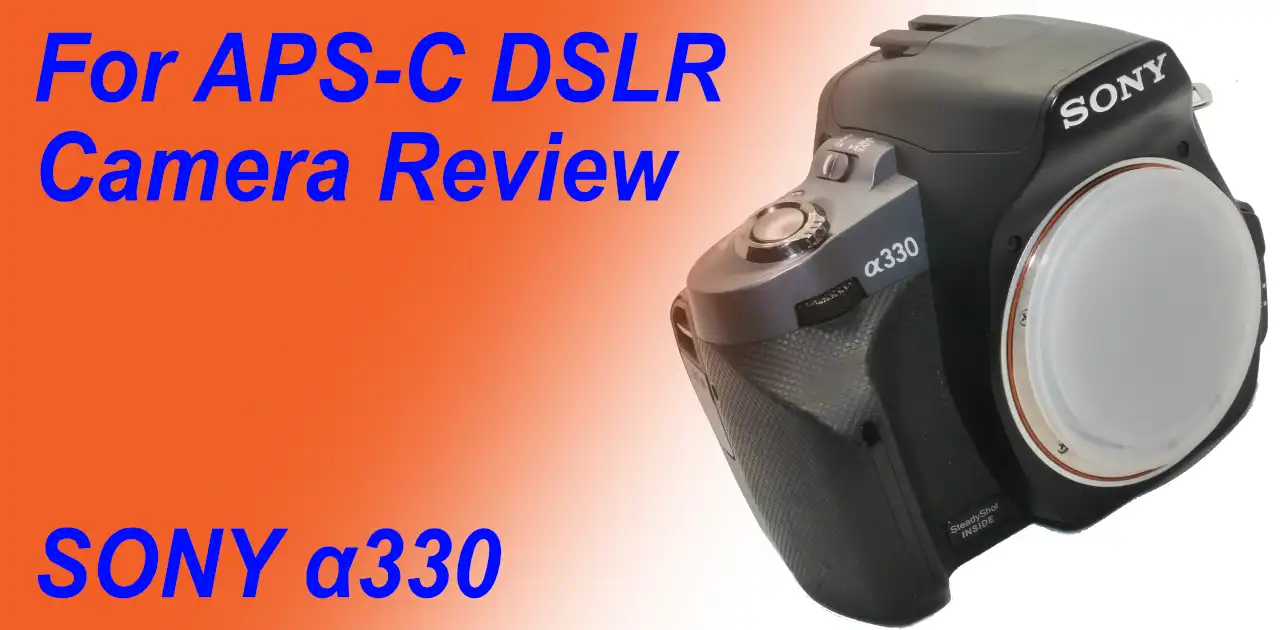
A review and sample photos of the Sony α330 digital SLR camera (released in 2009) using α-mount lenses.
- 本サイト表示の広告詳細は本リンク先に記載、本文の斜め文字のリンクはアフィリエイトリンク
- サイトについては、コメントまたは問い合わせフォームでご連絡ください。
- 引用、使用画像に関する問い合わせは権利者もしくはその代理の方からお願いします。
- Please see the disclaimer regarding advertising here.
- Italicized links in the text are advertisement links that take you to other sites.
- If you find any images used on this site problematic, please contact us via the comments or inquiry form, either as the rights holder or their representative. We will review the matter and take appropriate action.
Table of contents

Gallery
The following lenses were used to take the example photos.
- MINOLTA AF 35-105mm F3.5-4.5
- SONY DT 18-55mm F3.5-5.6
Review

1.Overview
The Sony α330, an entry-level digital SLR camera featuring a pentamirror, was released by Sony in June 2009. Although its exterior design has been updated and it is lighter than the α100 and α200 models, its basic performance remains largely unchanged.
The specifications are detailed in the table below, but here is an overview: It uses the α (A) mount, which is compatible with Minolta α lenses. It features a 10-megapixel, APS-C-size sensor and in-body image stabilization.
The camera’s dimensions are 12.8 cm (width), 9.7 cm (height), and 7.1 cm (depth), and it weighs 490 g.
When holding the camera, you will find a shooting mode dial on the right shoulder, a function dial on the left shoulder, and a directional pad for menu operation on the right side of the back. Only the physical dials and buttons necessary for operation are included.
Unlike higher-end models, it does not support replacing the viewfinder screen mat.
Although it has a live view function, the viewfinder is optical and does not display live view. Instead, you can check the image on the rear LCD screen.
Recording media is limited to SD cards and Memory Sticks, which can be used interchangeably. A switch near the slot allows you to switch between the two types of cards. The camera supports SDHC cards up to 32 GB.
Firmware version 1.10 has been released and is available for download from the Sony official website. To update, copy the unzipped firmware to the top of the memory card, then turn on the power while holding down the MENU button to display the update menu.
2.Usability
The Sony α330 is an entry-level digital single-lens reflex (SLR) camera with a body well-suited for use with standard and small wide-angle lenses.
It weighs 490 grams, which is 60 grams lighter than the α100 that I previously used. A key design change is the reshaped grip, which contributes to the camera’s compact appearance. While the new grip provides a decent hold, my little finger feels a bit left out. This is something I may get used to over time.
Disappointingly, the α330’s viewfinder magnification has decreased from 0.83x on the α100 to 0.74x. This makes manual focusing more difficult and transforms the α330’s viewfinder into one that is primarily suited for autofocus. I discuss the viewfinder in more detail in the “Usage and Considerations” section.
As far as the lenses used in this review are concerned, the autofocus accuracy and speed are acceptable for an entry-level camera. However, autofocus struggles with close-up shots and with objects obscured by wire mesh or bushes, as seen in the third example image. This makes manual focus desirable. The viewfinder’s performance is lacking, though, making manual focus shooting difficult and frustrating.
For these examples, I used two lenses: the “DT 18-55mm F3.5-5.6,” which is designed for APS-C size sensors, and the older autofocus “AF 35-105mm F3.5-4.5” lens for the 35mm film format.
Neither of these lenses supports interrupting manual focus, so the camera’s AF/MF switch must be used to change focus modes. This is an additional minor inconvenience.
The first example image was taken with the DT 18-55mm F3.5-5.6 lens, which is designed for APS-C size sensors. It was taken at the lens’s wide-angle end, which is equivalent to 27mm in the 35mm format. The image captures a distant view of Tokyo Station. Despite the combination of an inexpensive zoom lens and a 10-megapixel sensor, the image captures fine details. However, the resolution decreases at the edges.
The second image was taken with an AF 35-105mm f/3.5-4.5 lens at its widest setting (equivalent to 27mm in 35mm format) and captures a subject with straight lines sharply. In contrast, the third image was taken at an equivalent of 150mm (in 35mm format) with a minimum focusing distance of 85 cm and has a slightly dreamy, flared effect.
These results show that 10 megapixels are sufficient to capture the characteristics of the lens.
In order to use a manual focus lens with the α330, you must first set the mode dial to “M” (Manual). This allows the shutter to be released without electronic contacts. Unlike the α NEX series, the α330 does not have an “Release without Lens” ON/OFF option in the menu.
In the α330’s manual mode, photographers must manually set all shooting-related settings, including aperture, shutter speed, and ISO sensitivity. In other words, it’s a “hardcore” mode that rejects all program shooting assistance functions. It could be interpreted as the manufacturer declaring that those who cannot handle these settings are not qualified to use lenses without electronic contacts.
A more user-friendly camera would allow the photographer to set the aperture to A mode, which automatically determines the shutter speed and ISO sensitivity based on the light entering through the lens. However, the α330 cannot release the shutter in A mode. Therefore, when using a lens without electronic contacts, the shutter cannot be released in any mode other than manual.
The only unsatisfactory aspect of shooting was the operation of the exposure compensation, which I use most often. On the α330, exposure compensation is adjusted by pressing the button on the right shoulder of the camera and changing the exposure value using the dial on the front right. Ideally, the exposure would be adjustable without pressing a button, but according to the menu, this doesn’t seem possible. In A mode, you can change the exposure value with the dial, but this only adjusts the exposure value. The shutter speed automatically adjusts to achieve proper exposure. Therefore, to overexpose or underexpose, you must press the exposure compensation button and specify the exposure value.
Regarding the shutter sound, the mirror is small, and the continuous shooting speed is 2.5 frames per second, so it’s not very loud. However, silent shooting like with mirrorless cameras isn’t possible, so caution is needed when using it.
This camera was the first to adopt the NP-FH50 battery, which is almost the same size as the NP-FW50 battery used in later mirrorless cameras. However, they are not interchangeable due to their different shapes.
The card slot has a sliding cover with a sophisticated mechanism. It seems that considerable cost was invested in this feature. I acquired this camera secondhand, and the sliding cover still provides a secure seal with no signs of deterioration.

3.Summary
The Sony α330 is an entry-level digital single-lens reflex (SLR) camera with a 10-megapixel resolution. Even in the 2020s, it’s still capable of handling a certain level of photography.
As expected of an entry-level model, its usability lacks some features, but this is tolerable with a certain degree of compromise.
However, the difficulty of viewing through the viewfinder when manually focusing varies greatly from person to person, so it’s best to look through the viewfinder in person before making a decision.
Specifications, considerations, etc.
While the target audience for Sony’s entry-level α330 digital SLR camera may not use manual focus, Minolta’s entry-level cameras still featured decent viewfinders. As Sony evolved, however, this emphasis diminished.
The α550, released in Japan three months later, was Sony’s last SLR camera. Sony quickly abandoned traditional viewfinders in Japan, transitioning to cameras with electronic viewfinders and eventually mirrorless cameras. Overseas, one digital SLR model continued, but the shift towards mirrorless cameras occurred as well.
After the α900 in 2008, Minolta’s dedication to optical viewfinder technology was lost, and it became a so-called “lost technology.”
| Manufacturer | SONY | SONY |
| Camera name | α100 | α330 |
| Effective pixels of the camera | 10.2 megapixels | 10.2 megapixels |
| Sensor size | APS-C | APS-C |
| Back LDC Panel | 2.5 inches• 230,000 dots | 2.7 inches• 230,000 dots (Clear photo LCD, tiltable (approx. 135° up, approx. 55° down)) |
| LiveView | None | Exists |
| Finder | Roof mirror type, fixed at eye level | Pentamirror used, fixed eye level. |
| View finder Magnification | 0.83 (50mm lens, at infinity focus) | 0.74 (50mm lens, at infinity focus) |
| Maximum shutter speed | 1/4000 | 1/4000 |
| Frame Speed | 3 frames/second | 2.5 frames/second 2 frames/second(Live View) |
| ISO Sensitivity | 100-1600 | 100-3200 |
| Battery | NP-FM55H / NP-FM500H | NP-FH50 |
| Media | CF | SD/MS |
| Release date | 2006.7.21 | 2009.6.25 |
| Size(W x H x D mm) | 133.1×94.7×71.3 | 128 × 97× 71.4 |
| Weight (g) – Main unit only | 545 | 490 |
Opinions
- 外部フラッシュHVL-F56AM、HVL-F36AM
Reference links
- SONY α330 Official Page
- SONY α230, α330, α380 Firmware Download Page・SONY Official page
寄付のお願い・Request for donations
Affiliate links
- SONY・α・Ads by Amazon
- SONY lens・Ads by Amazon
- Sony camera books・Ads by Amazon
- SONY α100・Ads by Amazon
- SONY α100・Ads by Rakuten
- SONY α100・Ads by Yahoo Shopping

Update history
- 2026.5.24
Be First to Comment