
Last updated on 2026-05-25
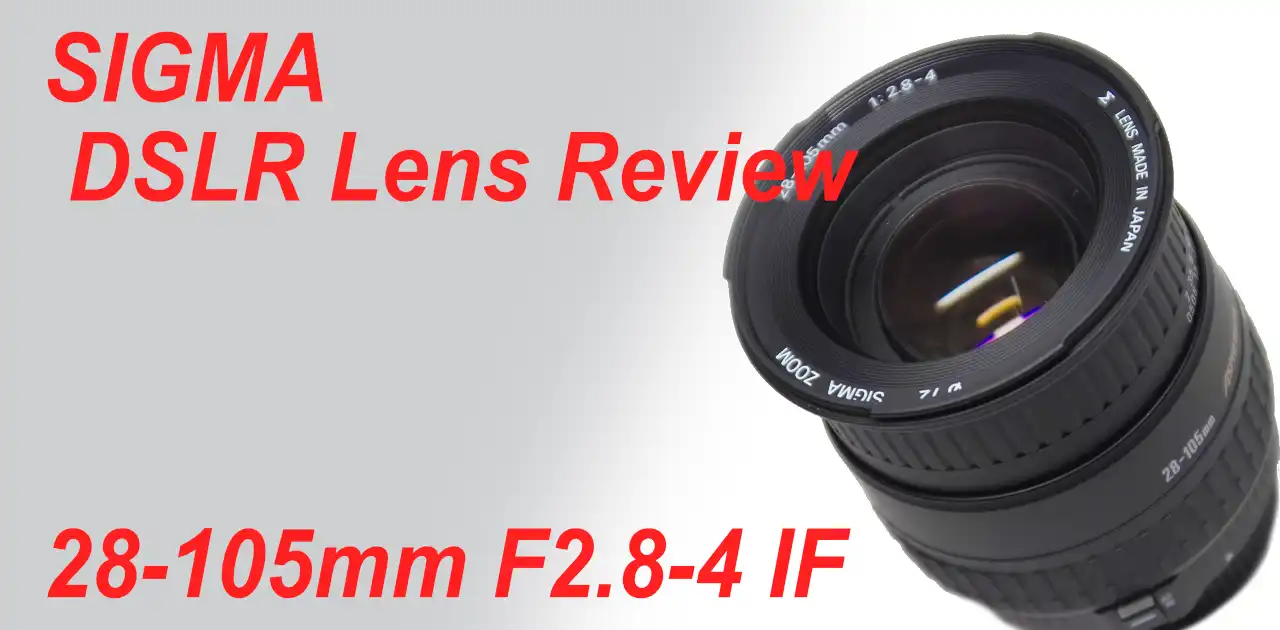
A review and sample images of the SIGMA 28-105mm F2.8-4 Aspherical standard zoom lens, released around 2000, used with a DSLR camera, the SIGMA SD9.
- Please see the disclaimer regarding advertising here.
- Italicized links in the text are advertisement links that take you to other sites.
- If you find any images used on this site problematic, please contact us via the comments or inquiry form, either as the rights holder or their representative. We will review the matter and take appropriate action.
Table of contents

Gallery
The following cameras were used to take the example photos.
- SIGMA SD-9
Review


1.Overview
The “SIGMA 28-105mm F2.8-4 Aspherical” is a standard zoom lens with a focal length of 28mm to 105mm and an aperture range of F2.8 to F4. It was released in 2000.
According to SIGMA’s naming convention, the term “Aspherical” indicates the use of an aspherical lens element.
While not explicitly stated, this lens has a design where the focus ring does not rotate during autofocus. However, the lens barrel extends and retracts from front to back when adjusting the focal length.
The main specifications are as follows, with further details shown in the table.
- Aperture: F2.8–4
- Lens Construction: 11 elements in 12 groups
- Aspherical lens element: 1
- Aperture Blades: 8
- Minimum Focusing Distance: 0.5m (across the entire zoom range)
- Lens Hood: Dedicated petal-shaped lens hood
2.Usability
The SIGMA 28-105mm F2.8-4 Aspherical is a standard zoom lens that was widely available in the 2000s. Its distinguishing features include a wide-angle end of 28 mm with a maximum aperture of f/2.8, which is half a stop brighter than the f/3.5 of more affordable standard zoom lenses. It extends to a telephoto end of 105 mm while maintaining a slightly brighter maximum aperture of f/4.
This lens fills the gap between the 28-80mm f/3.5-5.6 and the 28-135mm f/3.8-5.6, both of which are sold at roughly the same price. The aim of this lens was to offer a slightly brighter, more affordable standard zoom lens. This is likely because, in the era of film cameras, achieving low-noise images required the use of low-sensitivity film, such as ISO 100. This made even a half-stop brighter lens highly valued. Lenses with a constant aperture of f/2.8 across the entire zoom range are superior in quality but cost about twice as much. Therefore, there was likely a demand for an affordable, bright lens.
I used this lens with a SIGMA SD9 digital SLR camera. The SD9, a digital SLR camera from the 2000s, cannot increase ISO sensitivity, unlike digital cameras from the 2020s. Since shooting at ISO 100 was necessary, I purchased this lens because I wanted something a little brighter.
The SD9 has an APS-C-size sensor, which is smaller than a 35mm film sensor. Therefore, the 35mm film equivalent focal length is 50–180 mm (using a 1.7 conversion factor), resulting in a telephoto-oriented shooting range.
This lens comes with a petal-shaped lens hood and a non-rotating focus ring, which makes it easy to use with a PL filter. While this is an advantage when using a film camera, it can sometimes be replicated through image processing with digital cameras.
The minimum focusing distance is 0.4 meters across the entire zoom range. At a focal length of 105 millimeters, the magnification ratio is 1:5.5, which allows for closer focusing than that of some less expensive zoom lenses.
All example images were taken with a SIGMA SD9 digital SLR camera with a 3-megapixel, x3 FOVEON sensor. Since shooting took place during the day, the aperture was stopped down as needed. This is because lenses from this era generally produce better image quality when stopped down, provided there is sufficient light.
The first and second sample images were taken at wider focal lengths of 28 mm (50 mm equivalent) and 34 mm (50 mm equivalent), which allow for the capture of a reasonable amount of the surrounding area. Combined with the SD9’s rendering capabilities, even trees, which tend to exhibit false colors, are rendered precisely, demonstrating the lens’s sufficient performance for its era. This could be attributed to the small sensor size, which only shows the rendering of the central part of the lens.
The third and fourth images were taken with a telephoto lens. The 75 mm (128 mm equivalent) and 105 mm (180 mm equivalent) focal lengths demonstrate the compression effect typical of telephoto lenses. However, the bokeh of the cherry blossoms in the third image is noisy and unattractive, as is typical of older zoom lenses. The lens can focus as close as 0.4 m. However, depending on the scene, background rendering can be problematic. Therefore, it’s best to use it in scenes with a clean background of man-made objects or a dark background where the shape is not visible. This is largely due to the high-resolution characteristic of digital cameras. If you were shooting with a film camera, the background would be rendered more softly, and the noisiness of the bokeh would likely not be noticeable.
3.Summary
In summary, the SIGMA 28-105mm F2.8-4 Aspherical is an old film-era zoom lens, so its image quality is optimized for film use. Therefore, it’s understandable why it’s sold so cheaply secondhand in the 2020s.
It’s best suited for use with APS-C size sensors when used with a digital camera. Compared to inexpensive zoom lenses designed specifically for APS-C sensors starting at around 18mm, this lens offers better image quality in the center of the frame. Therefore, if you prioritize telephoto capabilities, this lens is a worthwhile option.
One drawback is that, although the minimum focusing distance is a respectable 0.4 m, the bokeh can be rough in some situations. However, this isn’t a major issue with inexpensive zoom lenses for APS-C sensors, so unless you’re comparing it to a prime lens, it should be competitive.
Specifications, considerations, etc.
Around 2000, Sigma had nine standard zoom lenses in its lineup, starting at 28mm. By 2008, this lineup had dwindled to three lenses, making Sigma’s standard zoom lenses in the early 2000s quite chaotic. Although Sigma has removed information on its older 2000s lenses from its official website, you can find it by searching their Web Archive.
- 28-70mmF2.8 EX ASPHERICAL
- 28-70mmF2.8-4 UC
- MINI ZOOM MACRO 28-80mm F3.5-5.6 ASPHERICAL HF
- MINI ZOOM MACRO 28-80mmF3.5-5.6
- 28-105mmF2.8-4 ASPHERICAL
- 28-105mmF3.8-5.6 UC-III ASPHERICAL IF
- 28-135mm F3.8-5.6 ASPHERICAL IF MACRO
- 28-200mmF3.5-5.6 DL ASPHERICAL HYPERZOOM MACRO
- 28-300mmF3.5-6.3 DL ASPHERICAL IF HYPERZOOM
| Items | 28-70mmF2.8 EX ASPHERICAL | MINI ZOOM MACRO 28-80mm F3.5-5.6 ASPHERICAL HF | 28-105mmF2.8-4 ASPHERICAL |
| Sensor size | 35mm full frame | 35mm full frame | 35mm full frame |
| Focal length(mm) | 28-70 | 28-80 | 28-105 |
| Max aperture | 2.8 | 3.5-5.6 | 2.8-4 |
| Min aperture | 32 | 22 | 22 |
| Leaf blade | 9 | 8 | 8 |
| Lens Construction | 15 elements in 12 groups | 7 elements in 7 groups | 12 elements in 11 groups |
| Min distance(m) | 0.4 | 0.5/(0.25) | 0.5 |
| Lens length(mm) | 101 | 71 | 79.5 |
| Max diameter(mm) | 83.5 | 70 | 77 |
| Filter Size(mm) | 77 | 55 | 72 |
| Weight(g) | 600 | 255 | 405 |
| accessories | Flower-shaped hood | Bayonet Cylindrical Hood | Flower-shaped hood |
| Release date | Around 2000 | Around 2000 | Around 2000 |
| Lens mount | SIGMA-SA CANON-EF NIKON-F α(DG) PENTAX | SIGMA-SA CANON-EF NIKON-F α(DG) PENTAX | SIGMA-SA CANON-EF NIKON-F α(DG) PENTAX |
| Price(JP-Yen/No-tax) | ¥65,000 | ¥33,000 | ¥39,000 |
Reference links
- 28-105mmF2.8-4 ASPHERICAL・WebArchive
- 28-70mmF2.8 EX ASPHERICAL・WebArchive
- MINI ZOOM MACRO 28-80mm F3.5-5.6 ASPHERICAL HF・WebArchive
寄付のお願い・Request for donations
Affiliate links
- Sigma・Ads by Amazon
- Sigma lens・Ads by Amazon
- Sigma books・Ads by Amazon

Update history
- 2026.5.23
Be First to Comment